Complete Guide to Choosing Ceramic Structured Tower Packing in India for Distillation Columns

Why Ceramic Honeycomb Is Essential for Modern Pollution Control
June 3, 2026
Why Activated Alumina Balls Are Essential for Industrial Air Drying Systems
June 8, 2026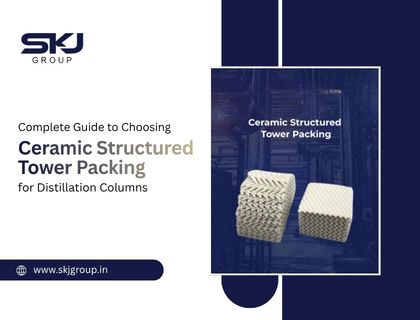
Distillation is one of the most energy-intensive processes in the chemical industry, accounting for nearly 40 percent of total energy consumption in chemical plants worldwide. The type of packing used inside a distillation column directly affects how much energy the column consumes, how clean the separation is, and how long the equipment lasts.
Ceramic Structured Tower Packing in India is widely chosen for distillation columns that handle corrosive chemicals, high temperatures, or systems where contamination from metal ions is not acceptable. SJK Group, a trusted Ceramic Structured Tower Packing manufacturer, supplies precision-made packing to refineries, chemical plants, and pharmaceutical facilities across India and international markets.
What is Ceramic Structured Tower Packing and How Does It Work?
Ceramic Structured Tower Packing is a type of distillation column internals made from ceramic material that is formed into a corrugated, geometrically arranged structure. Unlike random packing, which is poured loosely into a column, structured packing is stacked in organised layers inside the column.
Each layer has a specific channel geometry that guides liquid and vapour through defined flow paths. This controlled flow creates more consistent contact between the two phases, which is exactly what a distillation column needs for clean separation.
The ceramic material adds chemical resistance, thermal stability, and mechanical durability that metal or plastic alternatives cannot always provide. This is why Ceramic Structured Tower Packing in India is preferred for processes involving strong acids, alkalis, and temperatures above 250 degrees Celsius.
Why Choose Ceramic Structured Tower Packing for Distillation Columns
The choice of packing material is one of the most important engineering decisions in distillation column design. Here is why Ceramic Structured Tower Packing stands out:
Handles Extreme Temperatures Ceramic tolerates continuous operating temperatures well above what polypropylene or other plastics can handle. This makes it the right material for high-boiling-point separations in petrochemical and solvent recovery systems.
Resists Corrosive Chemicals Many distillation processes involve strong acids like hydrochloric acid, sulphuric acid, or acetic acid. Ceramic does not react with these chemicals, which means the packing stays intact and effective for years.
No Metal Ion Contamination In pharmaceutical and food-grade distillation, metal ions leaching from metal packing can cause product contamination. Structured ceramic packing eliminates this risk entirely.
High Mechanical Strength Ceramic structured packing withstands the weight of liquid holdup inside tall columns. Properly loaded ceramic packing does not compress or deform over time.
Low Liquid Holdup The channel geometry of high-performance tower packing allows liquid to drain efficiently between the layers. This keeps holdup volumes low and improves column responsiveness during start-up and shutdown.
How to Choose Ceramic Structured Tower Packing for Distillation Columns
Choosing the right Ceramic Structured Tower Packing in India for a distillation column involves evaluating several key factors. Getting this right from the start saves significant cost and rework later.
1. Operating Temperature Identifies the maximum temperature the packing will face during normal operation and peak conditions. Standard ceramic packing handles up to 1200 degrees Celsius. For very high-temperature applications, specific alumina or mullite-based ceramics may be needed.
2. Chemical Compatibility Check the process fluid against the ceramic material specification. Standard alumina ceramic works well in most acid and alkali environments. However, hydrofluoric acid environments require special material selection.
3. Column Diameter and Flow Rates Larger diameter columns need structured packing with appropriate channel dimensions to ensure even liquid distribution. The specific surface area of the packing must match the mass transfer requirement for the separation task.
4. Pressure Drop Requirements Each application has a pressure drop budget. Ceramic Structured Tower Packing with finer channels provides more surface area but slightly higher pressure drop. Coarser geometry gives lower pressure drop at the cost of some surface area.
5. Required Theoretical Stages The number of theoretical separation stages needed determines the total packing height required. Higher efficiency packing reduces the total height needed, which directly affects column cost and installation complexity.
6. Mechanical Load Consider the weight of ceramic packing in the loaded column. Support grids and column shells must be designed to handle the additional weight compared to metal or plastic packing options.
Comparison Table: Ceramic Structured Packing vs Other Distillation Packing Types
| Feature | Ceramic Structured Packing | Metal Structured Packing | Plastic Structured Packing |
| Max Temperature | Above 1200°C | Up to 500°C | Up to 120°C |
| Chemical Resistance | Excellent | Moderate | Good |
| Metal Ion Risk | None | Present | None |
| Pressure Drop | Low | Very Low | Low |
| Mechanical Strength | High | Very High | Moderate |
| Cost | Moderate | High | Low |
| Best For | Acid/Alkali Distillation | Hydrocarbon Refining | Mild Chemical Systems |
| Weight | Medium to Heavy | Medium | Very Light |
This comparison helps plant engineers quickly identify where Ceramic Structured Tower Packing in India delivers the best value for their specific process conditions.
Benefits of Ceramic Structured Tower Packing in Industrial Columns
The benefits of ceramic structured tower packing in industrial columns are well established across decades of use in chemical processing.
Better Mass Transfer Efficiency The ordered geometry of structured packing creates uniform vapour and liquid distribution. This improves mass transfer efficiency significantly compared to random packing of the same volume.
Lower Energy Consumption Better separation efficiency means fewer stages are needed, and the column can be operated at lower reflux ratios. This directly reduces reboiler energy consumption, which is typically the largest energy cost in a distillation unit.
Longer Service Life Industrial ceramic packing media does not corrode, does not fatigue from thermal cycling, and does not absorb the process chemicals it handles. Well-installed ceramic structured packing regularly achieves service lives of 10 years or more.
Consistent Product Quality Uniform flow distribution in structured packing produces more consistent separation results. This is particularly important in pharmaceutical distillation where product purity specifications are tight.
Reduced Column Height The high efficiency of chemical tower packing systems using structured ceramic packing means less total packing height is needed for the same separation. This reduces column capital cost and simplifies installation.
Factors Affecting Ceramic Packing Selection for Distillation Towers
Several technical factors affect which Ceramic Structured Tower Packing performs best for a given distillation tower:
- Specific surface area measured in square metres per cubic metre determines mass transfer capacity
- Void fraction affects pressure drop and liquid holdup
- Channel inclination angle influences the balance between capacity and efficiency
- Surface texture of the ceramic affects liquid spreading and wetting behaviour
- Packing height per element determines how many support grids are needed inside the column
SJK Group as a Ceramic Structured Tower Packing supplier provides full technical data sheets for each packing type, including flood point curves, mass transfer efficiency data, and pressure drop characteristics.
Authoritative reference: The American Institute of Chemical Engineers (aiche.org) publishes detailed guidelines on distillation column design and packing selection that support proper engineering decisions.
For Indian regulatory and process standards, the Bureau of Indian Standards (bis.gov.in) provides relevant material and equipment specifications that apply to column internals used in chemical plants.
Additional technical guidance on separation technology solutions and packing performance is available through NPTEL’s Chemical Engineering course materials at nptel.ac.in.
Best Ceramic Structured Packing for Chemical Distillation Processes
The best Ceramic Structured Tower Packing for a chemical distillation process depends on matching the packing specification to the process conditions rather than choosing based on cost alone.
For acid service applications like hydrochloric acid or acetic acid concentration, high-alumina ceramic with a 250Y or 350Y geometry is the standard choice. The Y designation refers to the channel angle, with 45 degrees being typical for most distillation duties.
For applications involving both high temperature and corrosive chemicals, mullite-based structured ceramic packing provides better performance than standard alumina because of its superior thermal shock resistance.
For pharmaceutical solvent recovery, finer channel geometries in the 500Y range deliver higher theoretical stage counts per metre of packing height, which reduces total column height and capital cost.
SJK Group as a Ceramic Structured Tower Packing exporter supplies all these configurations and provides technical support to match packing specification to process requirements accurately.
Case Study: Solvent Recovery Column Upgrade at a Pharmaceutical Plant in Hyderabad
A pharmaceutical manufacturer in Hyderabad was operating a solvent recovery distillation column using older random ceramic packing. The column was underperforming on product purity and consuming more steam than the design specification predicted.
The plant team contacted SJK Group for a technical review. After analysing the column dimensions, feed composition, operating pressure, and required product purity, SJK Group recommended replacing the existing random packing with Ceramic Structured Tower Packing in India using a 350Y alumina ceramic configuration.
The retrofit was completed during a scheduled maintenance outage over ten days.
Results measured after two months of continuous operation:
- Product purity improved from 96.2 percent to 99.1 percent
- Steam consumption at the reboiler reduced by 24 percent
- Column pressure drop decreased by 31 percent
- Column throughput capacity increased by 18 percent without any modification to the column shell
- The plant recovered the full retrofit investment cost within 14 months through energy savings alone
The plant engineering manager noted that the performance of Ceramic Structured Tower Packing from SJK Group exceeded the predicted values from the design calculations. The facility is now planning to retrofit a second column handling a different solvent system.
FAQ’s About Ceramic Structured Tower Packing
1. What is Ceramic Structured Tower Packing used for?
Ceramic Structured Tower Packing is used inside distillation columns to improve the contact between rising vapour and falling liquid. This contact enables separation of chemical mixtures. It is preferred in high-temperature and corrosive processes where metal or plastic packing cannot perform reliably over time.
2. How is structured packing different from random packing?
Structured packing is stacked in organised layers with defined channel geometry. Random packing is poured loosely into the column. Structured packing gives better mass transfer efficiency, lower pressure drop, and more uniform liquid distribution, which leads to better separation and lower energy consumption in most distillation applications.
3. What temperature can Ceramic Structured Tower Packing handle?
Standard alumina Ceramic Structured Tower Packing handles continuous operating temperatures above 1200 degrees Celsius. Mullite-based versions perform reliably in high thermal cycling conditions. This makes ceramic the best material choice for high-temperature chemical and petrochemical distillation processes.
4. How do I select the right packing size and geometry?
Selection depends on column diameter, required theoretical stages, acceptable pressure drop, and process fluid properties. Common geometries are 250Y and 350Y. SJK Group as a Ceramic Structured Tower Packing supplier provides technical data sheets and selection support to help engineers make the right choice.
5. Can Ceramic Structured Packing be used in vacuum distillation?
Yes. The low pressure drop characteristic of high-performance tower packing makes ceramic structured packing suitable for vacuum distillation systems. Maintaining low pressure drop is critical in vacuum columns to avoid pulling the column pressure below the acceptable operating range.
6. How long does Ceramic Structured Tower Packing last?
With correct installation and normal operating conditions, Ceramic Structured Tower Packing in India typically lasts 10 years or more. Service life depends on chemical exposure, thermal cycling frequency, and whether the packing is handled carefully during column maintenance and inspection shutdowns.
7. What is the advantage of ceramic over metal structured packing?
Ceramic structured packing eliminates the risk of metal ion contamination in pharmaceutical and food-grade applications. It also performs better in strong acid and alkali environments where metal packing corrodes over time. For high-temperature corrosive service, structured ceramic packing is the more reliable long-term choice.
8. Where can I source Ceramic Structured Tower Packing in India?
SJK Group is a trusted Ceramic Structured Tower Packing manufacturer in India and experienced Ceramic Structured Tower Packing exporter. We supply to chemical, pharmaceutical, petrochemical, and food processing industries. Contact us for technical specifications, pricing, and support for both new projects and column retrofit applications.
Conclusion
Choosing the right Ceramic Structured Tower Packing in India is one of the most impactful decisions in distillation column design and retrofit projects. The correct packing selection improves product purity, reduces energy costs, extends equipment life, and helps plants meet their production targets consistently.
Structured ceramic packing is the preferred choice when processes involve high temperatures, corrosive chemicals, or strict product purity requirements. Its combination of chemical resistance, thermal stability, and high mass transfer efficiency makes it suitable across a wide range of industries from pharmaceuticals to petrochemicals.
The factors that matter most during selection are operating temperature, chemical compatibility, required separation stages, acceptable pressure drop, and column diameter. Getting these right from the beginning prevents costly redesigns and performance shortfalls during plant operation.
Distillation column internals built around quality ceramic structured packing consistently outperform older random packing installations on energy efficiency and separation quality. The case study from Hyderabad confirms this with measurable, real-world results.
SJK Group brings the technical depth, product range, and supply reliability that column engineers need. As a trusted Ceramic Structured Tower Packing manufacturer, supplier, and exporter, the team provides full technical support from specification through to installation guidance.
Whether you are designing a new column or planning a retrofit, the right Ceramic Structured Tower Packing from SJK Group gives your distillation system the performance foundation it needs.