How ceramic saddles improve distillation efficiency in chemical plants

5A Molecular Sieve for Hydrocarbon Separation Applications
March 18, 2026
How to Choose PP Pall Ring Packing: Materials, Dimensions & Industrial Applications
April 6, 2026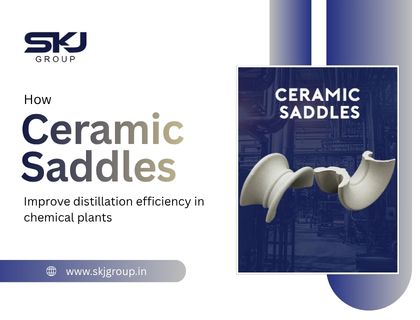
Chemical plant operators managing distillation columns face a consistent challenge. They need tower packing that maximizes contact between gas and liquid phases, withstands harsh chemical environments, operates effectively across a wide range of temperatures, and delivers consistent performance over extended operational periods without degradation.
Ceramic saddles in Mandsaur from SJK India have been meeting this challenge for chemical plants across petrochemical, pharmaceutical, fertilizer, and acid production industries. The unique geometry of ceramic saddles creates an internal column environment that promotes exceptional gas-liquid contact enhancement, which is the fundamental mechanism through which distillation efficiency is achieved.
Quick Fact: Tower packing geometry directly determines the available surface area for mass transfer within a distillation column. The saddle shape of ceramic saddles tower packing creates significantly more effective surface area per unit volume than older ring-based packing designs. This geometric advantage translates directly into higher separation efficiency, reduced column height requirements, and lower pressure drop across the packed bed, all of which reduce operational costs in chemical plants.
5 Key Ways Ceramic Saddles Improve Distillation Efficiency in Chemical Plants
1. They create exceptional surface area for gas-liquid contact within the distillation column. The saddle shape of ceramic saddles tower packing is specifically engineered to maximize the surface area available for mass transfer between rising vapor and descending liquid within the column. Unlike flat or cylindrical packing geometries, the curved saddle form creates multiple contact surfaces from every orientation within the packed bed. This multi-directional surface exposure means that vapor and liquid interact more completely across a given column height, producing higher separation efficiency per unit of packed volume. SJK India’s ceramic saddles in Mandsaur are manufactured to precise dimensional tolerances that ensure this surface area advantage is consistent across every piece in the packed bed.
2. They reduce pressure drop across the packed bed, lowering energy consumption in the distillation process. High pressure drop across a distillation column is one of the most significant contributors to operational energy costs in chemical plants. The open, interconnected void structure of intalox ceramic saddles allows vapor to flow through the packed bed with lower resistance than alternative packing designs. This reduced pressure drop means that the column can be operated at lower energy inputs while maintaining the same separation performance, or alternatively that higher throughput can be achieved at the same energy cost. The pressure drop advantage of ceramic saddle packing is one of the most commercially significant benefits recognized by ceramic saddles suppliers and plant engineers alike.
3. They provide outstanding corrosion resistance in acidic, alkaline, and solvent-based chemical environments. Corrosion-resistant packing media is a non-negotiable requirement in chemical plant distillation operations involving strong acids, caustic solutions, organic solvents, and halogenated compounds. Metal packing corrodes under these conditions, reducing its surface integrity and contaminating the product stream. Plastic packing softens and deforms at elevated temperatures. Ceramic saddles maintain their dimensional integrity, surface smoothness, and chemical inertness across virtually all industrial chemical environments, including concentrated sulfuric acid, hydrochloric acid, nitric acid, and caustic soda applications. This chemical durability makes ceramic saddle packing the most reliable long-term investment for demanding chemical separation processes.
4. They deliver consistent mass transfer efficiency across a wide operating temperature range. Many distillation operations involve elevated temperatures that exceed the safe operating range of plastic packing materials. Industrial distillation systems processing petroleum fractions, chlorinated compounds, and high-boiling-point organic chemicals routinely operate at temperatures that would compromise the structural integrity of non-ceramic packing options. Ceramic saddles in Mandsaur from SJK India are fired at high temperatures during manufacture, producing a dense, thermally stable ceramic body that maintains its geometry, surface area, and mass transfer performance at the elevated temperatures encountered in demanding packed column performance applications without thermal deformation or surface degradation.
3. They provide long service life that reduces maintenance downtime and replacement costs. Tower packing replacement requires column shutdown, which represents significant operational cost and production loss for chemical plants. The dense ceramic body of intalox ceramic saddles resists mechanical wear from gas and liquid flow, maintains its surface texture for sustained mass transfer performance, and does not degrade chemically under normal operating conditions. Chemical plants using quality ceramic saddles from a reputable ceramic saddles manufacturer like SJK India report extended packing service life that significantly reduces the frequency of column shutdowns for packing replacement, delivering sustained operational savings that justify the initial investment in quality ceramic tower packing.
How Ceramic Saddles Improve Distillation Column Efficiency
How ceramic saddles improve distillation column efficiency is best understood through the mass transfer mechanism that governs separation in packed columns.
In a distillation column, liquid flows downward over the packing surface while vapor rises upward through the void spaces between the packing pieces. The efficiency of separation depends on how completely the rising vapor equilibrates with the descending liquid at each point in the column. The greater the contact area, the more complete the equilibration, and the higher the separation efficiency per unit of column height.
Ceramic saddles tower packing contributes to this process through several simultaneous mechanisms:
- The curved saddle geometry creates continuous liquid film formation across multiple surfaces simultaneously.
- The open void structure prevents liquid channeling and ensures uniform liquid distribution across the column cross-section.
- The surface roughness of ceramic material promotes liquid film stability and vapor absorption at the gas-liquid interface.
- The random packing orientation of saddle-shaped pieces creates tortuous vapor flow paths that increase vapor-liquid contact time.
- The consistent geometry of quality ceramic saddles in Mandsaur ensures predictable packed bed behavior that plant engineers can rely on for column design calculations.
These combined effects produce a packed bed with mass transfer efficiency characteristics that consistently outperform alternative packing materials in controlled comparative testing and real-world plant applications.
Benefits of Using Ceramic Saddles in Chemical Plants
Benefits of using ceramic saddles in chemical plants extend beyond the fundamental mass transfer advantages to include operational, economic, and safety-related benefits:
1. Chemical Inertness
Ceramic material does not react with the process fluids passing through the column. This chemical inertness prevents product contamination, eliminates corrosion-related maintenance, and ensures that the packing does not introduce unwanted reactions into the chemical separation process.
2. Thermal Stability
The fired ceramic body of quality ceramic saddles maintains its dimensional and surface properties at temperatures that would soften or deform plastic packing and corrode metal packing. This makes ceramic the preferred material for high-temperature distillation operations.
3. Consistent Geometry
SJK India as a precision ceramic saddles manufacturer produces packing pieces to consistent dimensional specifications. This consistency ensures predictable void fraction, surface area, and pressure drop characteristics across the entire packed bed, which is essential for reliable column performance modeling and scale-up.
4. Environmental Compatibility
Ceramic materials are inert, non-toxic, and do not leach compounds into process streams. This makes ceramic saddles tower packing compatible with pharmaceutical, food-grade, and environmentally sensitive chemical processes where contamination prevention is critical.
Ceramic Saddles vs Alternative Tower Packing: Performance Comparison Table
| Property | Ceramic Saddles | Metal Raschig Rings | Plastic Packing | Metal Pall Rings |
| Chemical resistance | Excellent across all pH ranges | Limited in acidic environments | Limited at high temperatures | Moderate, corrodes in some acids |
| Temperature resistance | Very high | High | Low to moderate | High |
| Surface area per volume | High with saddle geometry | Moderate | Moderate | High |
| Pressure drop | Low with saddle shape | Higher than saddles | Low | Low |
| Mass transfer efficiency | High | Moderate | Moderate | High |
| Service life | Very long | Moderate, corrosion dependent | Short at high temperature | Moderate |
| Cost over operational life | Low due to longevity | Moderate | Low initial, high replacement | Moderate to high |
This comparison demonstrates why ceramic saddles in Mandsaur from SJK India are the preferred tower packing materials for chemical plants where chemical resistance, temperature stability, and long-term mass transfer efficiency are the primary selection criteria.
Role of Ceramic Saddles in Mass Transfer Operations
Role of ceramic saddles in mass transfer operations extends across a wide range of industrial applications beyond distillation:
1. Absorption Columns
In gas absorption operations where a liquid solvent removes a specific component from a gas stream, ceramic saddles tower packing provides the high surface area and low pressure drop required for efficient absorption. Applications include sulfur dioxide removal, hydrogen chloride absorption, and carbon dioxide scrubbing.
2. Stripping Columns
Stripping operations use a gas stream to remove dissolved components from a liquid. The uniform void structure and high surface area of intalox ceramic saddles support efficient stripping across a wide range of liquid and gas flow rates.
3. Liquid-Liquid Extraction
In liquid-liquid extraction columns where two immiscible liquid phases exchange components, ceramic saddles provide the surface area needed for phase contact while their chemical inertness prevents interference with either liquid phase.
4. Quench Towers and Scrubbers
Industrial distillation systems often include quench towers and gas scrubbers that protect downstream equipment. The thermal stability and chemical resistance of ceramic saddles make them ideal for these high-temperature, chemically aggressive applications.
Case Study
A sulfuric acid manufacturing plant in central India was experiencing reduced absorption efficiency in its oleum absorption tower. The existing packing had degraded over several years of operation in the highly corrosive acid environment, leading to increased acid mist emissions and reduced product concentration consistency.
The plant engineering team contacted SJK India as a trusted ceramic saddles supplier and ceramic saddles exporter with extensive experience in acid plant applications. Following a technical assessment, SJK India supplied a complete repacking solution using intalox ceramic saddles manufactured to precise specifications at their ceramic saddles in Mandsaur facility.
Following repacking, the plant reported improved absorption efficiency and more consistent product acid concentration. The engineering team noted that the new ceramic saddles tower packing delivered noticeably lower pressure drop than the degraded previous packing, reducing blower energy consumption measurably. The plant has continued to operate with the SJK India ceramic saddles packing without requiring replacement through subsequent operating cycles.
FAQ’s About Ceramic Saddles
Q1. How do ceramic saddles improve distillation column efficiency?
Ceramic saddles increase gas-liquid contact surface area, reduce pressure drop, and promote uniform liquid distribution, all improving distillation separation efficiency.
Q2. What are the benefits of using ceramic saddles in chemical plants?
Ceramic saddles offer chemical inertness, thermal stability, high mass transfer efficiency, long service life, and consistent packed bed performance in chemical plants.
Q3. What is the best tower packing material for distillation efficiency?
Ceramic saddles are the best packing material for distillation operations requiring chemical resistance, high temperature stability, and sustained mass transfer efficiency.
Q4. What is the role of ceramic saddles in mass transfer operations?
Ceramic saddles maximize vapor-liquid contact in distillation, absorption, stripping, and extraction columns through their high surface area and open void structure.
Q5. Why use ceramic saddles in packed column distillation?
Ceramic saddles provide superior surface area, chemical resistance, thermal stability, and low pressure drop that make them ideal for packed column distillation applications.
Q6. What are intalox ceramic saddles and why are they preferred?
Intalox ceramic saddles are an optimized saddle geometry that provides higher surface area and lower pressure drop than standard saddle and ring packing designs.
Q7. How long do ceramic saddles last in chemical plant applications?
Quality ceramic saddles from a reliable manufacturer provide very long service life in chemical plant applications when operated within recommended temperature and loading parameters.
Q8. Can ceramic saddles be used in highly acidic or alkaline environments?
Yes. Ceramic saddles are chemically inert and maintain their integrity in concentrated acids, strong alkalis, and most aggressive industrial chemical environments.
Conclusion
Distillation efficiency in chemical plants depends on the quality and geometry of the tower packing chosen. Ceramic saddles deliver the surface area, chemical resistance, thermal stability, and low pressure drop that demanding industrial distillation systems require. Whether the application involves acid absorption, solvent distillation, or gas scrubbing, ceramic saddles tower packing consistently outperforms alternatives in chemically aggressive and high-temperature environments. SJK India as a trusted ceramic saddles manufacturer, ceramic saddles supplier, and ceramic saddles exporter provides precisely manufactured ceramic saddles in Mandsaur that meet the technical demands of chemical plants across India and global markets. Quality packing is not a cost. It is the foundation of efficient, reliable, and profitable plant operation.