Industrial Burner Efficiency with Infrared Honeycomb Ceramic Plates

Industrial and Commercial Construction Applications of Premium Plywood
February 2, 2026
Fine Chemical Separation Using Metal Gauze Structured Packing
February 9, 2026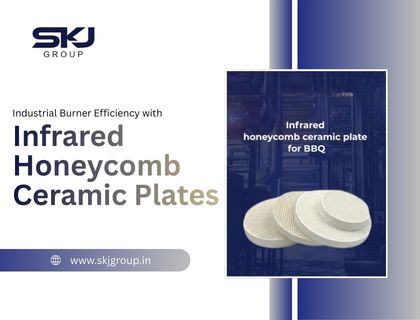
Industrial facilities worldwide face mounting pressure to reduce energy consumption while maintaining optimal production output. Infrared honeycomb ceramic plates have emerged as a game-changing solution for companies seeking to maximize gas burner efficiency improvement and minimize operational costs. As a leading infrared honeycomb ceramic plate manufacturer, SJK India recognizes the transformative impact these advanced components deliver to industrial heating applications.
The adoption of infrared ceramic burner plates represents a significant technological advancement in combustion systems. These specialized components convert traditional flame-based heating into radiant infrared energy, delivering superior heat transfer, reduced emissions, and substantial fuel savings across diverse industrial processes.
Understanding Infrared Honeycomb Ceramic Technology
Infrared honeycomb ceramic plates feature a distinctive cellular structure consisting of thousands of small channels that create a massive surface area within a compact form factor. This unique design enables uniform gas distribution and complete combustion, transforming standard burners into energy-efficient industrial burners with infrared ceramic plates.
The honeycomb ceramic burner media operates on the principle of surface combustion rather than traditional open-flame burning. When fuel-air mixture passes through the honeycomb channels, it ignites across the entire ceramic surface, creating consistent radiant heat ceramic plates that emit infrared energy directly to the target material.
High-temperature ceramic honeycomb structures withstand extreme operating conditions, typically rated for continuous use at temperatures exceeding 1000°C. The material composition includes aluminum oxide, silicon carbide, and specialized binders that provide exceptional thermal shock resistance and structural integrity.
How Infrared Honeycomb Ceramic Plates Improve Industrial Burner Efficiency
1. Enhanced Heat Transfer Mechanisms
Infrared honeycomb ceramic plates achieve superior efficiency through direct radiative heat transfer. Unlike convective heating methods that warm surrounding air before transferring energy to materials, infrared radiation travels directly from the ceramic surface to the workpiece, minimizing energy waste.
This direct heat transfer mechanism provides several critical advantages:
- Faster heating cycles reducing production time
- Lower ambient temperature requirements improving workplace comfort
- Reduced heat loss to surrounding environments
- More precise temperature control across heating zones
- Improved product quality through uniform heating
The radiative efficiency of best ceramic honeycomb plates for industrial gas burners typically exceeds 85%, compared to 50-65% efficiency in conventional flame burners. This dramatic improvement translates directly to industrial burner fuel savings with infrared ceramic honeycomb plates ranging from 20% to 40% depending on application specifics.
2. Complete Combustion and Emission Reduction
Low emission industrial burners using honeycomb ceramic technology achieve near-complete combustion due to the extended residence time of fuel-air mixture within the honeycomb channels. This thorough combustion process significantly reduces harmful emissions including carbon monoxide, unburned hydrocarbons, and nitrogen oxides.
Environmental regulatory compliance becomes simpler when facilities deploy infrared honeycomb ceramic plate suppliers products meeting current emission standards. Many jurisdictions now mandate stricter air quality controls, making the transition to cleaner combustion technology both economically and legally advantageous.
The uniform temperature distribution across the ceramic surface prevents hot spots that typically generate excessive NOx emissions in conventional burners. This characteristic makes infrared ceramic burner plates particularly valuable in applications requiring both high thermal output and stringent emission compliance.
Industrial Applications of Infrared Honeycomb Ceramic Plates
1. Manufacturing and Processing Industries
Powder coating operations benefit tremendously from how infrared honeycomb ceramic plates improve industrial burner efficiency. The consistent infrared output ensures even curing across complex geometries without the scorching or incomplete curing common with convective ovens.
Textile processing facilities utilize infrared honeycomb ceramic plates for drying and heat-setting operations. The rapid heating capability reduces processing time while the controllable infrared intensity prevents fabric damage that can occur with direct flame exposure.
Metal treatment processes including annealing, tempering, and brazing achieve more predictable results with radiant heat ceramic plates. The uniform heating pattern reduces thermal stress and improves metallurgical outcomes across various alloy compositions.
2. Food Processing and Commercial Kitchens
Commercial food production relies heavily on precise temperature control and energy efficiency. Infrared honeycomb ceramic plate in India installations in bakery ovens, roasting equipment, and industrial grilling systems deliver consistent results while reducing natural gas consumption.
The flameless operation of honeycomb ceramic burner media provides safety advantages in food processing environments where grease accumulation presents fire hazards. The ceramic surface operates at controlled temperatures that minimize ignition risks compared to open-flame burners.
3. Building Materials and Glass Manufacturing
Brick, tile, and ceramic manufacturing processes require sustained high temperatures over extended periods. High-temperature ceramic honeycomb burners provide the thermal stability needed for quality product output while maintaining gas burner efficiency improvement that impacts bottom-line profitability.
Glass forming and annealing operations demand precise temperature profiles that infrared honeycomb ceramic plate exporters products deliver consistently. The rapid response characteristics of ceramic burners enable tight process control during critical forming stages.
Case Study: Automotive Parts Manufacturer Achieves 35% Energy Savings
A major automotive components manufacturer in Maharashtra partnered with SJK India to retrofit their powder coating line with infrared honeycomb ceramic plates. The facility operated 16 hours daily, processing metal parts requiring cure temperatures of 180-200°C.
1. Previous System Challenges:
- Inconsistent coating quality requiring rework
- High natural gas consumption averaging 450 cubic meters daily
- Difficulty maintaining temperature uniformity across oven zones
- Excessive NOx emissions approaching regulatory limits
2. Solution Implementation:
SJK India supplied custom-sized infrared ceramic burner plates designed specifically for the client’s oven dimensions. The installation replaced 24 conventional atmospheric burners with 18 infrared honeycomb units, leveraging the superior heat transfer to reduce burner count while improving performance.
3. Measurable Results After Six Months:
- Natural gas consumption reduced to 290 cubic meters daily (35% savings)
- Coating defect rate decreased from 8% to under 2%
- Oven heat-up time reduced from 45 minutes to 22 minutes
- NOx emissions lowered by 60%, providing comfortable compliance margin
- Annual energy cost savings exceeding
The rapid payback period of 14 months justified the capital investment, with the client subsequently planning to retrofit additional production lines with energy-efficient industrial burners with infrared ceramic plates.
Technical Specifications and Selection Criteria
Choosing appropriate infrared honeycomb ceramic plates requires careful consideration of application parameters. Key specification factors include:
1. Operating Temperature Range:
- Low-temperature applications (150-400°C) for drying and curing
- Medium-temperature operations (400-800°C) for most industrial heating
- High-temperature processes (800-1200°C) requiring specialized ceramic formulations
Plate Dimensions and Configuration: Standard sizes range from 150mm x 150mm to 600mm x 600mm, with custom dimensions available from leading infrared honeycomb ceramic plate manufacturer facilities. Thickness typically varies between 12mm and 25mm depending on structural requirements and thermal mass considerations.
2. Fuel Compatibility:
- Natural gas (most common application)
- Liquefied petroleum gas (LPG)
- Biogas and renewable fuel sources
- Mixed fuel applications with proper controls
Infrared honeycomb ceramic plate suppliers provide technical data sheets specifying heat flux rates, pressure drop characteristics, and recommended fuel-air ratios for optimal performance across different fuels.
Installation and Maintenance Best Practices
Successful implementation of best ceramic honeycomb plates for industrial gas burners depends on proper installation procedures. Critical considerations include:
- Adequate clearance for thermal expansion during heat cycling
- Uniform gas distribution manifold design preventing flow imbalances
- Appropriate mounting hardware resistant to thermal stress
- Proper insulation minimizing reverse heat loss
- Safety interlocks preventing fuel flow without ignition confirmation
Maintenance requirements for infrared honeycomb ceramic plates prove minimal compared to conventional burners. Periodic inspection schedules should verify:
- Ceramic surface integrity checking for cracks or erosion
- Burner port cleanliness ensuring unrestricted gas flow
- Ignition system functionality confirming reliable startup
- Control system calibration maintaining temperature accuracy
The robust construction of high-temperature ceramic honeycomb typically delivers 5-7 years of continuous operation before replacement becomes necessary, significantly exceeding the lifespan of metal burner components.
Economic and Environmental Benefits
Industrial burner fuel savings with infrared ceramic honeycomb plates extend beyond direct energy cost reductions. Facility managers report additional economic advantages including:
- Reduced maintenance labor due to fewer burner servicing requirements
- Lower replacement parts inventory costs
- Decreased production downtime from more reliable operation
- Improved product quality reducing scrap and rework expenses
- Enhanced workplace comfort from lower ambient temperatures
Environmental stewardship increasingly influences industrial purchasing decisions. Low emission industrial burners using honeycomb ceramic technology help companies meet sustainability commitments while satisfying stakeholder expectations for responsible manufacturing practices.
Carbon footprint reduction achieved through energy-efficient industrial burners with infrared ceramic plates contributes to corporate environmental, social, and governance (ESG) metrics that investors and customers increasingly scrutinize. Documentation from infrared honeycomb ceramic plate exporters provides the technical data needed for carbon accounting and sustainability reporting.
Comparing Infrared Ceramic Technology to Conventional Burners
Traditional atmospheric burners mix fuel and air at the burner head, creating an open flame that heats through convection and conduction. This approach suffers from inherent inefficiencies as significant energy escapes with combustion products before transferring to the workpiece.
Infrared honeycomb ceramic plates fundamentally change this dynamic by converting chemical energy into infrared radiation at the ceramic surface. The infrared wavelengths penetrate materials more effectively, delivering energy where needed rather than heating the surrounding air mass.
Turndown ratio represents another critical performance difference. Conventional burners typically achieve 3:1 or 4:1 turndown, while infrared ceramic burner plate systems commonly provide 10:1 or greater turndown capability. This flexibility enables precise heat matching to varying process loads without cycling burners on and off.
According to the U.S. Department of Energy’s Advanced Manufacturing Office, infrared heating systems can reduce energy consumption by 20-50% compared to conventional methods. Their research validates the efficiency gains reported by infrared honeycomb ceramic plates in India installations across diverse industrial sectors.
The Canadian Standards Association provides comprehensive testing protocols for infrared gas-fired heaters, establishing safety and performance benchmarks that quality infrared honeycomb ceramic plate manufacturer facilities reference during product development.
Future Trends in Industrial Heating Technology
Innovation continues advancing honeycomb ceramic burner media capabilities. Emerging developments include:
- Enhanced ceramic formulations extending operational temperature ranges
- Integrated sensors enabling real-time combustion optimization
- Modular burner designs simplifying retrofit installations
- Advanced surface coatings improving radiation efficiency
- Smart controls leveraging artificial intelligence for predictive maintenance
Research institutions worldwide investigate next-generation ceramic compositions that promise even greater efficiency gains. The International Energy Agency projects continued growth in industrial heat pump deployment, with infrared ceramic technology complementing these systems in hybrid configurations.
FAQ’s About Infrared Honeycomb Ceramic Plates
1. How does the infrared gas burner work?
Infrared gas burners pass fuel-air mixture through ceramic honeycomb channels where surface combustion occurs, converting energy into infrared radiation efficiently.
2. What is a ceramic burner?
A ceramic burner uses porous ceramic media as combustion surface, enabling flameless operation with superior heat transfer through infrared radiation.
3. Is a ceramic plate heat resistant?
Yes, industrial ceramic plates withstand continuous operation exceeding 1000°C, providing exceptional thermal shock resistance and durability under extreme conditions.
4. What is the difference between a gas burner and an infrared burner?
Gas burners use open flames for convective heating while infrared burners employ ceramic surfaces for radiant heat transfer with higher efficiency.
5. What are the advantages of an infrared stove?
Infrared stoves provide faster heating, better temperature control, reduced emissions, improved energy efficiency, and safer flameless operation compared to conventional stoves.
6. Are infrared burners better?
Infrared burners typically outperform conventional burners through 20-40% higher efficiency, lower emissions, uniform heating, and reduced fuel consumption across applications.
7. What are the advantages of infrared heating?
Infrared heating offers direct heat transfer, rapid response, zone control capability, reduced air heating losses, and improved process quality outcomes.
8. What are the advantages of infrared burners?
Infrared burners deliver enhanced efficiency, lower emissions, uniform heat distribution, reduced maintenance, improved safety, and significant fuel cost savings.
9. Is an infrared gas stove more efficient?
Yes, infrared gas stoves achieve 85%+ efficiency versus 50-65% for conventional stoves, reducing energy consumption and operational costs substantially.
10. What are common problems with infrared heaters?
Common issues include ceramic plate cracking from thermal shock, uneven gas distribution, ignition system failures, and gradual efficiency degradation without maintenance.
Conclusion
Infrared honeycomb ceramic plates represent proven technology delivering measurable efficiency improvements and emissions reductions across industrial heating applications. The combination of superior heat transfer, extended component life, and substantial fuel savings creates compelling economic justification for upgrading conventional burner systems. As infrared honeycomb ceramic plate manufacturer capabilities advance and environmental regulations tighten, adoption of this technology will accelerate. Facilities implementing energy-efficient industrial burners with infrared ceramic plates gain competitive advantages through lower operating costs and enhanced sustainability credentials.
Partner with SJK India for Superior Infrared Ceramic Solutions
Transform your industrial heating systems with advanced infrared honeycomb ceramic plates from SJK India. As a trusted infrared honeycomb ceramic plate manufacturer, we deliver customized solutions engineered for your specific application requirements.
Our comprehensive product range includes infrared ceramic burner plates for diverse temperature ranges, fuel types, and process conditions. Whether you need best ceramic honeycomb plates for industrial gas burners or specialized configurations for unique applications, our technical team provides expert guidance from initial consultation through installation and beyond.