How Metal Corrugated Plate Structured Packing Enhances Mass Transfer Efficiency

Why Activated Alumina Balls Are Essential for Industrial Air Drying Systems
June 8, 2026
4A Molecular Sieve for Oxygen Generation Plants: Complete Buying Guide
June 13, 2026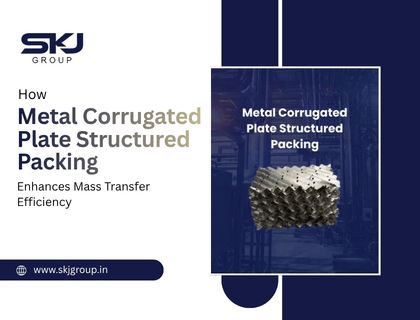
Distillation and absorption columns consume nearly 40 percent of all energy used in chemical processing plants worldwide. A large portion of that energy is wasted when the packing inside the column does not distribute vapour and liquid evenly. Poor distribution leads to poor separation, which forces plants to run at higher reflux ratios and consume more steam or energy to compensate.
Metal Corrugated Plate Structured Packing in India directly solves this problem. Its precisely engineered corrugated channel structure creates controlled flow paths that maximise contact between rising vapour and falling liquid at every point in the column. SJK Group, a reliable Metal Corrugated Plate Structured Packing manufacturer, supplies this packing to petrochemical refineries, chemical plants, pharmaceutical facilities, and gas processing units across India and export markets.
What is Metal Corrugated Plate Structured Packing?
Metal Corrugated Plate Structured Packing is a type of column internal made from thin metal sheets that are pressed or corrugated into a regular wave pattern and then arranged into structured layers inside a distillation or absorption tower.
Each corrugated sheet has a specific channel angle, typically 45 or 60 degrees, that guides vapour and liquid along defined flow paths. Adjacent sheets are oriented in opposite directions so their channels cross each other. This crossing geometry forces the two phases to mix repeatedly as they travel through the packing bed.
The result is very efficient vapour-liquid contact efficiency across the full diameter of the column. Unlike random packing, where flow paths vary unpredictably, Metal Corrugated Plate Structured Packing in India provides consistent, repeatable performance that plant engineers can design around with confidence.
How Metal Corrugated Plate Structured Packing Improves Mass Transfer Efficiency
Mass transfer performance is the core measure of how well a column separates or purifies a mixture. The higher the mass transfer rate, the fewer theoretical stages the column needs, which directly reduces column height and capital cost.
How metal corrugated plate structured packing improves mass transfer efficiency comes down to three design features working together:
Controlled Flow Distribution The corrugated channels direct liquid to spread evenly across the full surface of each sheet. This prevents the liquid from channeling down one side of the column, which is one of the most common causes of poor separation in industrial towers.
Large Effective Contact Surface Each square metre of column cross-section filled with Metal Corrugated Plate Structured Packing exposes several hundred square metres of wetted metal surface to the vapour stream. This large active surface is where mass transfer actually takes place, so more surface means more efficient separation.
Repeated Mixing at Channel Crossings Every time the flow crosses from one channel to another at the corrugation intersection, the vapour and liquid phases mix again. This repeated mixing refreshes the concentration gradient between the phases, which drives faster mass transfer throughout the entire packing height.
Together, these three mechanisms explain why structured packing for distillation columns consistently outperforms random packing on a mass transfer per unit volume basis.
Benefits of Metal Corrugated Structured Packing in Distillation Columns
The benefits of metal corrugated structured packing in distillation columns are well documented across decades of industrial application worldwide.
High Mass Transfer Efficiency Metal Corrugated Plate Structured Packing in India achieves a higher number of theoretical separation stages per metre of packing height than equivalent random packing. This reduces the total packing height needed, which lowers column fabrication cost.
Low Pressure Drop The open channel geometry creates very little resistance to vapour flow. Low pressure drop packing is especially important in vacuum distillation, where maintaining very low column pressure is critical to the separation process.
Higher Throughput Capacity The structured flow paths allow higher vapour and liquid flow rates before flooding occurs. This means existing columns can be debottlenecked by replacing random packing with high-capacity distillation packing without modifying the column shell.
Excellent Liquid Distribution Corrugated surface texture promotes liquid spreading across the full sheet surface. This keeps the entire packing bed active and prevents the formation of dry zones that reduce separation efficiency.
Reduced Energy Consumption Better separation process optimization means columns can achieve the same product purity at lower reflux ratios. Lower reflux directly reduces reboiler duty, which is usually the single largest energy cost in a distillation unit.
Wide Material Options Metal Corrugated Plate Structured Packing is available in stainless steel 304 and 316L, carbon steel, titanium, duplex steel, and other alloys. This range of materials covers virtually every corrosive or high-temperature process condition found in industrial plants.
Long Service Life Metal structured packing does not degrade, compress, or lose its geometry under normal operating conditions. Well-installed stainless steel structured packing regularly achieves service lives of 10 to 20 years in refinery and chemical plant applications.
Comparison Table: Metal Corrugated Plate Structured Packing vs Other Packing Types
| Feature | Metal Corrugated Plate Structured | Metal Random Packing | Ceramic Structured Packing |
| Mass Transfer Efficiency | Very High | Moderate | High |
| Pressure Drop | Very Low | Moderate | Low |
| Throughput Capacity | High | Moderate | Moderate |
| Liquid Distribution | Excellent | Variable | Good |
| Temperature Resistance | High | High | Very High |
| Chemical Resistance | Good to Excellent | Good | Excellent |
| Weight | Light to Medium | Medium | Heavy |
| Best Application | Distillation, Absorption | General Separation | Acid/Alkali Distillation |
| Service Life | 10 to 20 Years | 5 to 10 Years | 10 to 15 Years |
This comparison shows clearly why Metal Corrugated Plate Structured Packing in India is the first choice for high-performance distillation and absorption columns in the chemical and petrochemical sectors.
Metal Corrugated Plate Packing for Reducing Pressure Drop in Towers
Pressure drop is a critical operating parameter in distillation columns. In atmospheric and pressure distillation, high pressure drop increases the temperature at the bottom of the column, which can cause product degradation or require higher reboiler temperatures.
In vacuum distillation, even small increases in pressure drop can shift the actual column pressure far above the design vacuum level, completely changing the separation equilibrium and ruining product quality.
Metal corrugated plate packing for reducing pressure drop in towers addresses this directly. The open channel structure allows vapour to flow through the packing bed with minimal resistance. Typical pressure drops for Metal Corrugated Plate Structured Packing are between 1 and 3 millibars per theoretical stage, compared to 5 to 10 millibars per stage for equivalent random packing.
This five-fold reduction in pressure drop is what makes Metal Corrugated Plate Structured Packing in India the standard choice for vacuum distillation applications in pharmaceutical and fine chemical plants.
Best Metal Structured Packing Solutions for Enhanced Vapour-Liquid Contact
Selecting the best metal structured packing solutions for enhanced vapour-liquid contact requires matching the packing specification to the column operating conditions.
The key specifications to evaluate are:
Specific Surface Area Measured in square metres per cubic metre, this determines the available contact surface per unit of column volume. Common values range from 125 to 750 square metres per cubic metre. Higher surface area gives more transfer stages per metre but increases pressure drop slightly.
Channel Angle A 45-degree channel angle (Y geometry) gives a balance of capacity and efficiency for most applications. A 60-degree angle (X geometry) gives higher capacity at slightly lower efficiency and is used in high-throughput columns.
Sheet Texture Smooth sheets suit clean services. Perforated or embossed textures improve liquid spreading for better wetting in low liquid rate applications or systems with high surface tension fluids.
Material Grade For standard hydrocarbon and solvent services, stainless steel 304 or 316L covers most requirements. For highly corrosive acids or high-temperature services, titanium or high-alloy materials are available from SJK Group as a Metal Corrugated Plate Structured Packing supplier.
According to the American Institute of Chemical Engineers (aiche.org), structured packing selection has a direct impact on column efficiency, energy use, and capacity. Proper specification reduces both capital and operating costs over the column lifetime.
The Institution of Chemical Engineers (icheme.org) also publishes technical guidance on industrial mass transfer equipment selection that supports informed decision-making during column design and retrofit projects.
For detailed mass transfer correlations and packing performance data, NPTEL’s Chemical Engineering resources at nptel.ac.in provide reliable academic and engineering reference material.
High-Efficiency Metal Structured Packing for Chemical Separation Processes
High-efficiency metal structured packing for chemical separation processes is particularly valuable in applications where product purity requirements are very tight and column space is limited.
In pharmaceutical solvent recovery, achieving purities above 99.5 percent requires a large number of theoretical stages in a short column height. Metal Corrugated Plate Structured Packing in India with high specific surface area, such as 500 or 750 square metres per cubic metre configurations, delivers the stage count needed while keeping the column compact.
In petrochemical fractionation, where throughput volumes are very large, the capacity advantage of structured packing allows columns to handle higher feed rates without flooding. This is directly valuable in refinery debottlenecking projects where adding new column shells is not practical.
In gas absorption applications, the low pressure drop of tower packing for chemical processing using metal corrugated plate designs reduces blower energy and improves overall system efficiency for gas scrubbing and treatment operations.
Case Study: Petrochemical Refinery in Gujarat Improves Column Separation with Metal Structured Packing
A mid-size petrochemical refinery near Vadodara, Gujarat was operating a C4 fractionation column using metal Pall ring random packing. The column was struggling to meet product specification on butylene purity, and the reboiler was operating at maximum duty without achieving the required separation.
The refinery process engineering team contacted SJK Group for a technical assessment. After reviewing the column dimensions, feed composition, operating pressure, and required product specification, SJK Group recommended a full retrofit with Metal Corrugated Plate Structured Packing using 250Y geometry stainless steel 316L configuration.
The retrofit was completed during a planned turnaround over 12 days.
Results measured after 60 days of continuous operation:
- Butylene product purity improved from 94.3 percent to 98.7 percent
- Reboiler steam consumption reduced by 27 percent
- Column pressure drop decreased by 38 percent
- Column throughput capacity increased by 22 percent without any change to the column shell
- The full retrofit cost was recovered through energy savings in less than 18 months
The refinery chief engineer noted that the mass transfer performance improvement was visible within the first week of operation and remained consistent across changing feed compositions and seasonal temperature variations.
The facility has since approved a second retrofit covering two additional fractionation columns using Metal Corrugated Plate Structured Packing from SJK Group.
FAQs About Metal Corrugated Plate Structured Packing
1. What is Metal Corrugated Plate Structured Packing used for?
Metal Corrugated Plate Structured Packing is used inside distillation, absorption, and stripping columns to improve contact between vapour and liquid phases. It is widely used in petrochemical refining, chemical manufacturing, pharmaceutical solvent recovery, and gas treatment applications where high separation efficiency and low pressure drop are required.
2. How does Metal Corrugated Plate Structured Packing improve mass transfer efficiency?
The corrugated channel geometry spreads liquid evenly across the packing surface and forces repeated mixing at channel crossings. This continuous mixing refreshes the concentration gradient between vapour and liquid phases, which drives faster mass transfer performance throughout the column and produces more efficient separation per metre of packing height.
3. What is the difference between 250Y and 500Y structured packing geometry?
The number refers to the specific surface area in square metres per cubic metre. 250Y has lower surface area, lower pressure drop, and higher capacity. 500Y has higher surface area and more theoretical stages per metre but slightly higher pressure drop. SJK Group as a Metal Corrugated Plate Structured Packing supplier advises on the right geometry for each specific application.
4. Can Metal Corrugated Plate Structured Packing be used in vacuum distillation?
Yes. The very low pressure drop of low pressure drop packing using metal corrugated plate geometry makes it ideal for vacuum distillation. Maintaining low column pressure drop is essential in vacuum systems to prevent the actual operating pressure from rising above the design vacuum level during normal operation.
5. What materials are available for Metal Corrugated Plate Structured Packing?
Metal Corrugated Plate Structured Packing in India is available in stainless steel 304, 316L, carbon steel, duplex stainless steel, titanium, and other high-alloy metals. Material selection depends on the process fluid chemistry, operating temperature, and corrosion requirements of the specific column application.
6. How long does Metal Corrugated Plate Structured Packing last?
Quality stainless steel structured packing installed correctly in a well-operated column typically lasts between 10 and 20 years. Service life depends on chemical exposure, mechanical handling during maintenance, thermal cycling, and whether the column operates within the designed flow rate range throughout its service period.
7. Can structured packing replace random packing in an existing column?
Yes. Replacing random packing with Metal Corrugated Plate Structured Packing in India is one of the most common column retrofit projects in the chemical industry. It typically improves separation efficiency, reduces pressure drop, and increases throughput capacity without requiring any modification to the existing column shell or internals structure.
8. Where can I source Metal Corrugated Plate Structured Packing in India?
SJK Group is a trusted Metal Corrugated Plate Structured Packing manufacturer in India and experienced Metal Corrugated Plate Structured Packing exporter. We supply stainless steel and alloy structured packing to refineries, chemical plants, and pharmaceutical facilities. Contact us for specifications, pricing, and technical support for new projects and retrofit applications.
Conclusion
Metal Corrugated Plate Structured Packing in India has established itself as the highest-performing column internal for distillation, absorption, and stripping applications across the chemical, petrochemical, and pharmaceutical sectors.
Its corrugated channel geometry delivers superior vapour-liquid contact efficiency, very low pressure drop, and high throughput capacity in the same column volume. These three performance advantages directly translate into lower energy costs, better product purity, and higher plant throughput for any column that makes the switch from random packing.
Separation process optimization using metal structured packing is not just a technical upgrade. It is a financial decision that delivers measurable returns through reduced steam consumption, lower maintenance costs, and improved product quality. The case study from Gujarat confirms this with hard operational data.
As Indian industry continues to expand and environmental and product quality standards become stricter, the demand for high-capacity distillation packing that delivers both performance and efficiency will only grow. Plants that invest in quality Metal Corrugated Plate Structured Packing now will be better positioned for the operating environment of the next decade.
Choosing the right packing specification requires technical knowledge of the process conditions and an understanding of how different geometries and surface areas perform across varying operating points. SJK Group brings this expertise to every project.
As a trusted Metal Corrugated Plate Structured Packing manufacturer, reliable Metal Corrugated Plate Structured Packing supplier, and experienced Metal Corrugated Plate Structured Packing exporter, SJK Group supports customers from initial specification through to supply, installation guidance, and long-term technical support.