Ceramic Structured Packing for Carbon Capture (CCUS) Columns: What Plant Engineers Need to Know

Why 13X Molecular Sieve Is the Preferred Choice for PSA Oxygen Generation Systems
July 25, 2026
Role of Molecular Sieves in Biogas Upgrading to Bio-CNG (SATAT Scheme Guide)
August 11, 2026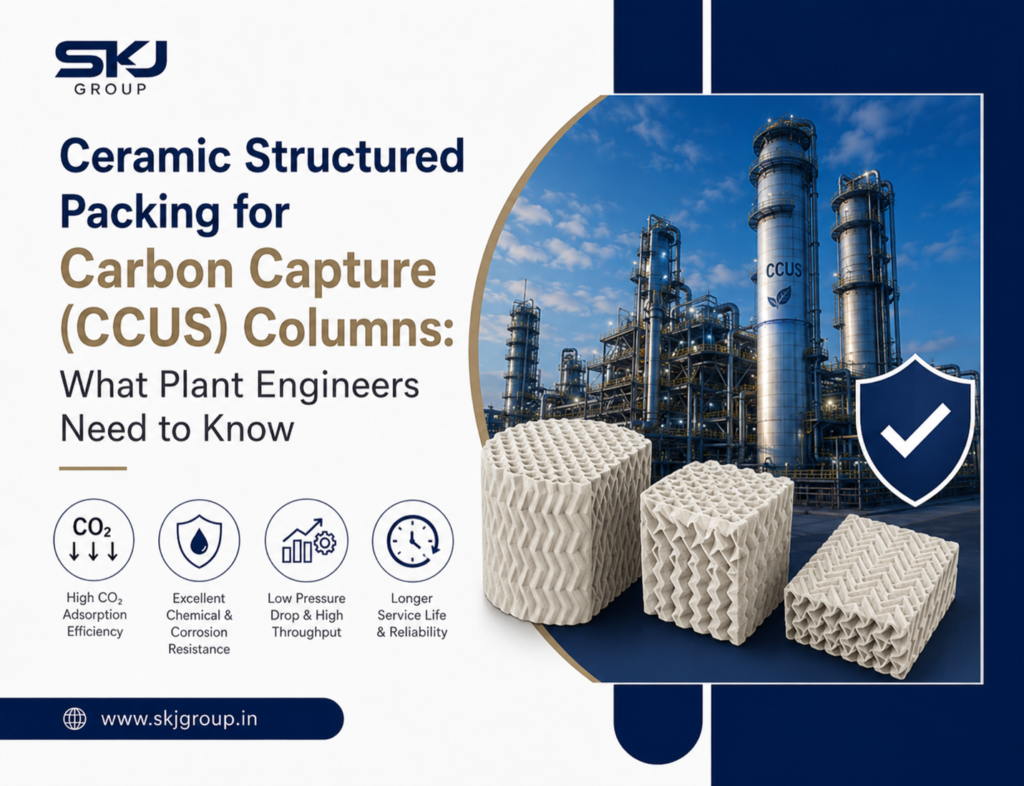
Carbon capture, utilisation, and storage (CCUS) is moving from pilot projects to real industrial deployment across India and the world. At the heart of every CO2 absorption unit sits one critical component: the packing inside the column. Ceramic structured packing for carbon capture (CCUS) columns is gaining attention because it offers the surface area, chemical resistance, and thermal stability that modern absorption processes demand. This guide explains what plant engineers need to know before specifying packing for a CCUS project.
What Is Ceramic Structured Packing for CCUS Columns?
Ceramic structured packing is a precisely arranged, corrugated-sheet packing material installed inside absorption or stripping columns. Unlike random packing, which is dumped loosely into a tower, structured packing is stacked in a fixed geometric pattern.
This arrangement creates consistent, thin liquid films across a large surface area. In a CCUS system, this surface is where flue gas meets the amine or solvent solution, and where CO2 transfers from the gas phase into the liquid phase.
Ceramic structured packing for CCUS applications is chosen specifically because ceramic material resists degradation from amine solvents, acidic condensates, and repeated heating and cooling cycles that occur during absorption and solvent regeneration.
Why CO2 Absorption Columns Need the Right Packing
Every CCUS plant, whether it captures CO2 from a cement kiln, a power plant, or a refinery flue stack, relies on a packed absorption column as its core unit. The gas rises through the column while a solvent, usually an amine-based liquid, flows downward.
Ceramic packing for CO2 absorption increases the contact time and contact area between these two streams. More contact means more CO2 molecules are captured before the treated gas exits the top of the column.
Research on post-combustion capture confirms that packing geometry directly affects capture rate, since the overall process depends on gas-liquid hydrodynamics inside the column and the reaction kinetics of the solvent This is why packing selection is not a minor detail. It is a design decision that shapes the entire economics of a capture plant.
Key Properties Engineers Should Check Before Selecting Ceramic Structured Packing
Before finalizing a ceramic structured packing for CCUS order, plant engineers typically evaluate the following properties.
- Specific surface area: Higher surface area per cubic metre generally improves mass transfer, but it can also raise pressure drop.
- Chemical resistance: The packing must withstand amine solvents, degradation products, and acidic gases such as SO2 and NOx present in flue gas.
- Thermal stability: Absorption and stripping sections operate at different temperatures, so the material must handle repeated thermal cycling without cracking.
- Wettability: A surface that liquid spreads across evenly avoids dry spots, which reduce absorption efficiency.
- Mechanical strength: The packing must support its own weight and the load above it inside a tall column, sometimes 15 to 25 metres high.
Ceramic packing for carbon capture columns performs well against most of these criteria, particularly in applications where corrosion resistance matters more than absolute minimum weight.
Ceramic vs Metal Structured Packing for Carbon Capture Columns
Plant engineers often compare ceramic and metal structured packing before finalizing a CCUS project. Both are used in industry, but each has distinct advantages.
| Parameter | Ceramic Structured Packing | Metal Structured Packing |
| Corrosion resistance | Excellent against acids and amine degradation products | Good, but can corrode over time with acidic condensate |
| Thermal stability | High, handles wide temperature swings | High, but prone to fatigue over long cycles |
| Weight | Heavier per unit volume | Lighter, easier to install in tall columns |
| Cost | Generally lower for large-diameter columns | Higher for corrosion-resistant alloys |
| Typical use case | Acidic flue gas streams, high-temperature zones | Standard flue gas without heavy acidic contaminants |
Neither option is universally better. The right choice depends on flue gas composition, solvent type, and the specific corrosion profile of the plant.
How Ceramic Structured Packing Improves CO2 Capture Efficiency
Ceramic structured packing for CO2 absorption contributes to plant performance in several measurable ways.
- It creates a large, uniform gas-liquid interface, which increases the rate of CO2 mass transfer.
- It reduces the height of packing needed to achieve a target capture rate, which can lower capital cost for the column.
- It maintains consistent performance even as flue gas temperature and flow rate fluctuate during plant operation.
- It resists fouling and scaling better than some random packing shapes, reducing maintenance frequency.
Studies on absorber packed height for power plants using post-combustion capture have shown that packing type has a direct effect on the mass transfer coefficient and, by extension, the size and cost of the absorption column (MDPI Sustainability). Choosing structured packing for CO2 removal with the right geometry is therefore a cost-control decision as much as a technical one.
Common Challenges in CCUS Absorption Columns and How Packing Design Helps
CCUS plants face a few recurring operational challenges, and packing design plays a role in managing each one.
Channeling and uneven liquid flow can reduce absorption efficiency significantly. Structured packing with proper liquid distributors and wettable ceramic surfaces reduces this risk compared to poorly designed random packing beds.
Amine degradation and foaming create fouling deposits inside the column. Ceramic surfaces are generally less reactive with degraded amine byproducts than some metals, which helps reduce fouling over time.
Pressure drop across the column affects the energy required to move flue gas through the system. Structured packing, including ceramic variants, typically offers lower pressure drop than random packing for the same separation performance, which supports lower operating costs.
India’s Growing CCUS Sector and Where Ceramic Packing Fits In
India has set a national target of net-zero emissions by 2070, and CCUS is being positioned as one tool for hard-to-abate sectors such as cement, steel, and power generation. The Union Budget for 2026-27 allocated significant funding toward CCUS development, alongside a national CCUS research roadmap released by the Department of Science and Technology .
As Indian cement, fertilizer, and refinery plants begin piloting CO2 capture units, demand for reliable ceramic tower packing and structured packing suppliers is expected to grow. Plants that plan early for absorption column design, including packing selection, will be better positioned when CCUS mandates or carbon pricing mechanisms expand.
Globally, the IEA notes that operational carbon capture capacity crossed roughly 50 million tonnes per year as of early 2025, with capacity expected to expand significantly by 2030 as more projects move from planning to construction . Every new absorption column built during this expansion will need a packing decision, and that decision affects performance for the life of the plant.
Choosing the Right Ceramic Structured Packing Supplier for CCUS Projects
Selecting a supplier for ceramic packing for industrial columns used in CCUS projects requires more diligence than a standard tower packing order, because CO2 capture columns run continuously and are expensive to shut down for repacking.
Engineers should look for a supplier that can:
- Provide material test certificates confirming chemical resistance and thermal ratings.
- Manufacture custom sizes and shapes to match specific column diameters and internals.
- Demonstrate experience supplying packing for chemical, petrochemical, or environmental columns with similar operating conditions.
- Support technical discussions on packing height, surface area, and expected pressure drop for the intended flue gas composition.
SKJ Group manufactures ceramic tower packing and structured ceramic materials used across chemical processing, gas purification, and absorption applications in India. While every CCUS project has unique specifications, working with an experienced ceramic packing manufacturer early in the design phase helps avoid costly redesigns later.
FAQs About Ceramic Structured Packing for Carbon Capture (CCUS) Columns
1. What is ceramic structured packing used for in carbon capture columns?
Ceramic structured packing is used inside CO2 absorption columns to increase contact between flue gas and the solvent solution. This contact allows more CO2 to transfer from the gas into the liquid, improving overall capture efficiency.
2. Is ceramic or metal structured packing better for CCUS applications?
It depends on the flue gas composition. Ceramic structured packing generally performs better in acidic or highly corrosive conditions, while metal structured packing may be preferred where weight and installation ease are the priority.
3. How does ceramic structured packing affect CO2 capture efficiency?
It increases the surface area available for gas-liquid contact, which raises the mass transfer rate. This can reduce the required packing height and lower the overall pressure drop across the column.
4. Can ceramic structured packing handle high-temperature flue gas streams?
Yes. Ceramic materials generally offer strong thermal stability and can withstand repeated heating and cooling cycles common in absorption and solvent regeneration stages.
5. Where can I source ceramic structured packing for a CCUS project in India?
Established ceramic tower packing manufacturers with experience in chemical and gas processing columns, such as SKJ Group, can supply and customize structured packing for CO2 capture applications based on specific plant requirements.
Conclusion
As CCUS moves from pilot scale to commercial deployment in India, packing selection will directly influence plant efficiency, operating cost, and long-term reliability. Ceramic structured packing for carbon capture (CCUS) columns offers a proven combination of chemical resistance, thermal stability, and mass transfer performance that plant engineers can rely on when designing new absorption systems.
If your team is evaluating packing options for an upcoming CO2 capture, gas absorption, or scrubbing project, SKJ Group can help you select and customize the right ceramic structured packing for your column specifications. Contact SKJ Group today for a technical consultation and a quote tailored to your plant’s operating conditions.