Role of Molecular Sieves in Biogas Upgrading to Bio-CNG (SATAT Scheme Guide)

Ceramic Structured Packing for Carbon Capture (CCUS) Columns: What Plant Engineers Need to Know
August 11, 2026
What Determines Molecular Sieve 13X Price? A Buyer’s Guide to Cost Factors and Supplier Comparison
August 15, 2026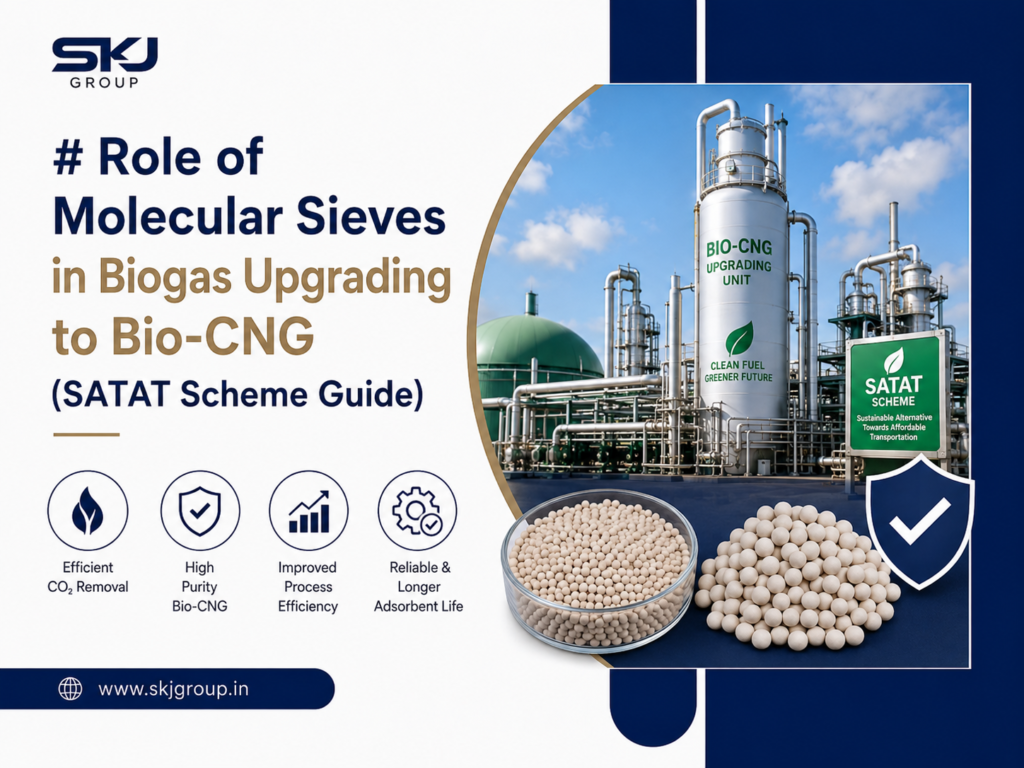
India is racing to convert farm waste, cattle dung, and municipal garbage into clean vehicle fuel. At the centre of this transformation sits a quiet but powerful material: the molecular sieve. The role of molecular sieves in biogas upgrading to Bio-CNG is simple to state but critical in practice they strip out carbon dioxide, moisture, and hydrogen sulphide from raw biogas so that what remains is high-purity methane, ready to be compressed and sold as Bio-CNG under the government’s SATAT scheme.
This guide explains how molecular sieve adsorbents work inside a compressed biogas (CBG) plant, why the right grade matters, and what plant owners should look for when sourcing industrial molecular sieves in India.
What Is Bio-CNG and Why Does the SATAT Scheme Matter?
Bio-CNG, also called compressed biogas (CBG), is purified biogas compressed to the same quality standard as fossil-based CNG. It is produced from organic waste such as crop residue, cattle dung, sewage sludge, and food waste through anaerobic digestion.
The SATAT scheme (Sustainable Alternative Towards Affordable Transportation) was launched by the Ministry of Petroleum and Natural Gas in October 2018. Its goal is to set up thousands of CBG plants across India and integrate compressed biogas into the existing CNG supply network.
More recently, the government introduced a CBG Blending Obligation that requires gas distribution companies to blend a rising share of compressed biogas into CNG and PNG supply, starting at a small percentage and increasing year on year through the rest of this decade. This blending mandate has turned biogas upgrading from an optional add-on into a core requirement for every CBG plant that wants to sell into the formal gas grid.
Raw biogas straight out of a digester is not fit for this purpose. It typically contains 55 to 65 percent methane, along with carbon dioxide, moisture, and trace hydrogen sulphide. To meet Bio-CNG specifications, methane content must be raised above 90 percent. That upgrading step is where molecular sieves for biogas purification come in.
What Are Molecular Sieves and How Do They Work?
A molecular sieve is a synthetic crystalline material, usually a zeolite, with a uniform network of microscopic pores. These pores are sized precisely enough to let small molecules like water and carbon dioxide pass in and adsorb onto the internal surface, while larger methane molecules pass through largely untouched.
This size-selective behaviour makes molecular sieves ideal for gas separation. Unlike simple filters that block particles by physical size, a molecular sieve adsorbent works on a molecular level, targeting specific compounds based on their kinetic diameter and polarity.
In industrial gas processing, molecular sieves are most often used in a pressure swing adsorption (PSA) system. The gas stream is passed through beds packed with sieve material under pressure. Impurities get trapped in the pores while purified gas exits the far end. When a bed becomes saturated, pressure is released to desorb the trapped gas, and the cycle repeats with a fresh bed taking over. This continuous swing between adsorption and regeneration is what allows a CBG plant to run around the clock.
Role of Molecular Sieves in Biogas Upgrading to Bio-CNG
The role of molecular sieves in biogas upgrading to Bio-CNG centres on three jobs that happen in sequence inside a PSA-based upgrading skid.
1. Moisture removal. Raw biogas leaving the digester is saturated with water vapour. Left untreated, this moisture corrodes compression equipment and interferes with downstream CO2 adsorption. A molecular sieve for gas purification, typically an activated alumina or 4A grade, dries the gas to a very low dew point before it moves to the next stage.
2. Carbon dioxide removal. This is the heart of biogas upgrading. Research on zeolite adsorbents shows that both 4A and 13X molecular sieves can selectively adsorb CO2 from a methane-rich stream, with 13X generally offering higher CO2 capacity and 4A offering faster, more economical regeneration. Selecting the right molecular sieve for CO2 removal directly affects methane recovery rate and product purity, which is why plant designers size and grade their PSA beds carefully.
3. Hydrogen sulphide removal. Even trace levels of H2S are corrosive and must be stripped out before compression. Studies on PSA units for biogas cleaning have used 5A and 13X molecular sieves specifically for this purpose, since these grades combine acid-gas capacity with practical regenerability in continuous operation. A dependable molecular sieve for H2S removal protects compressors, storage cylinders, and downstream vehicles from sulphur-related corrosion.
Together, these three functions of molecular sieve for methane purification turn a 55–65 percent methane raw biogas stream into pipeline-grade Bio-CNG with methane content above 90 percent, matching the quality benchmark set for CNG.
Choosing the Right Molecular Sieve Adsorbent for Biogas Upgrading
Not every CBG plant needs the same molecular sieve adsorbent for biogas upgrading. The right choice depends on feedstock, gas flow rate, and moisture load. A few practical guidelines:
- 4A molecular sieve is commonly used for pre-drying stages and offers cost-effective, fast regeneration cycles.
- 13X molecular sieve delivers higher CO2 adsorption capacity, making it a strong fit for plants processing high-CO2 feedstock such as press mud or food waste.
- 5A molecular sieve is often selected where selective separation of nitrogen or trace impurities alongside CO2 and H2S is required.
- Bead size, crush strength, and moisture resistance should match the specific PSA vessel design to avoid excess pressure drop and premature attrition.
Plants that get this selection wrong often see lower methane recovery, higher energy consumption per cycle, and shorter adsorbent life, all of which quietly erode plant economics over time.
Why This Matters for CBG Plant Economics Under SATAT
Under SATAT, oil marketing companies purchase CBG at prices linked to its calorific value and purity. A plant that consistently hits high methane purity earns a better price and a more reliable offtake relationship with its buyer. Since molecular sieves are the component directly responsible for that purity, adsorbent quality has a direct line to plant revenue.
Poor-quality or incorrectly sized sieves also increase downtime for bed replacement and regeneration troubleshooting. For a plant running under a long-term OMC offtake agreement, unplanned downtime is a real cost, not just an inconvenience.
This is why experienced CBG plant developers work with established molecular sieve manufacturers in India rather than treating the adsorbent as a commodity purchase. Consistent pore structure, verified crush strength, and batch-to-batch quality control matter as much as the headline molecular sieve price.
Sourcing Industrial Molecular Sieves in India
India’s compressed biogas sector is scaling quickly, and demand for reliable industrial molecular sieves is scaling with it. When evaluating a molecular sieve supplier in India, plant owners and EPC contractors should look for:
- Documented adsorption capacity and crush strength test data
- Consistent bead size distribution suited to your PSA vessel design
- Proven experience supplying 4A, 5A, and 13X grades for gas purification applications
- Reliable delivery timelines to avoid production downtime during commissioning or bed replacement
SKJ Group manufactures and supplies a full range of molecular sieves, including 3A, 4A, 5A, 13X, and 13X-HP grades, for gas drying, CO2 removal, and H2S removal applications across India’s growing compressed biogas and industrial gas sectors.
Faqs About Role of Molecular Sieves in Biogas Upgrading to Bio CNG
1. What is the main role of molecular sieves in biogas upgrading?
Molecular sieves remove moisture, carbon dioxide, and hydrogen sulphide from raw biogas through selective adsorption, raising methane content to the 90 percent-plus level required for Bio-CNG.
2. Which molecular sieve is best for CO2 removal in CBG plants?
13X molecular sieve generally offers higher CO2 adsorption capacity, while 4A molecular sieve is valued for faster and more economical regeneration. Plant designers often choose based on feedstock composition and CO2 load.
3. How does the SATAT scheme relate to biogas upgrading technology?
SATAT promotes the production and sale of compressed biogas (Bio-CNG) through a formal procurement mechanism with oil marketing companies. Biogas upgrading using molecular sieves is the technical step that makes raw biogas meet the purity standard SATAT and CBG blending rules require.
4. Can the same molecular sieve remove both CO2 and H2S from biogas?
Some grades, particularly 13X and 5A, have been used in combined PSA systems for both CO2 and H2S removal, though many plants use dedicated beds or layered systems for each impurity to optimise performance and adsorbent life.
5. How often do molecular sieves need to be replaced in a CBG plant?
Replacement intervals depend on gas flow rate, moisture load, and regeneration practice, but typically range from two to five years. Regular monitoring of breakthrough performance helps plants schedule replacement before purity drops.
Get the Right Molecular Sieve for Your Biogas Upgrading Plant
If you are setting up or upgrading a compressed biogas plant under the SATAT scheme, adsorbent quality is not a place to cut corners. SKJ Group supplies industrial-grade molecular sieves engineered for consistent CO2 removal, H2S removal, and gas drying performance.
Contact SKJ Group today for technical guidance, product datasheets, and a quote tailored to your CBG plant’s flow rate and feedstock profile.