What is the Purpose of a PP Pall Ring?

What is a Ceramic Honeycomb Structure in Construction?
November 18, 2024
The Purpose of Inert Ceramic Balls: Benefits & Applications in Industrial Processes
November 22, 2024
This image displays a PP Pall Ring, a widely used packing material in chemical and industrial towers. Designed to improve gas-liquid contact, it enhances mass transfer efficiency, reduces pressure drop, and supports stable flow distribution. Engineers and plant operators choose PP Pall Rings to optimize process efficiency, reduce operational costs, and extend equipment life, making them an essential component in distillation, absorption, and scrubbing systems.
A PP Pall Ring is a polypropylene random packing that improves contact between gas and liquid in absorption, scrubbing and stripping towers. Its open, windowed wall gives a large wetted surface with low pressure drop, and polypropylene resists many acids and alkalis. It suits moderate temperatures, usually 60 to 100 °C depending on resin grade, so confirm the limit for your duty.
Here is how it works, which size to pick, where it fits and what to check before you buy.
Quick facts
- Type: Random packing, loaded by dumping into the tower
- Material: Polypropylene (PP)
- Purpose: Gas and liquid contact for mass transfer
- Typical void fraction: About 90 to 92%
- Best for: Scrubbers, absorbers, strippers and degassing towers
- Not for: Hot distillation, strong oxidising chemicals or solvents that swell polypropylene
What Does a PP Pall Ring Do Inside a Tower?
A Pall ring is a short cylinder with two rows of windows in the wall and tongues bent inward. Each ring is moulded as one piece, and many rings settle into a loose bed.
- More contact: The windows and inner surfaces give gas and liquid a large wetted area to meet on.
- Lower pressure drop: The open wall lets gas pass through, so blowers use less power.
- Better liquid spread: Liquid moves through the windows and across the bed instead of running down the tower wall.
- Corrosion resistance: Polypropylene does not rust and handles many acids and alkalis.
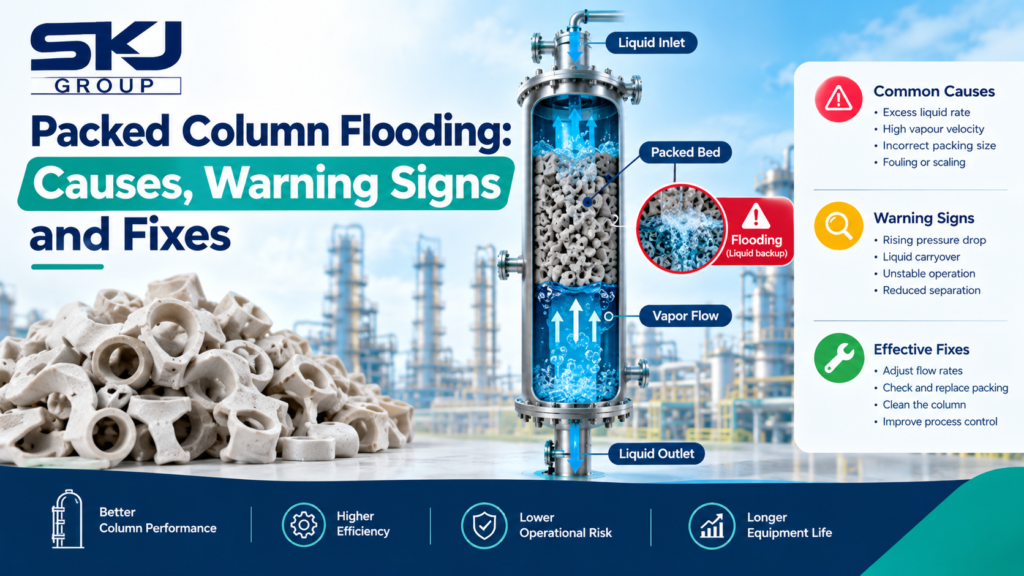
Packing cannot fix every problem. A poor liquid distributor or a pushed column can still cause channelling or flooding. Our guide to packed column flooding causes and fixes shows what to check.
Which PP Pall Ring Size Should You Choose?
Common sizes are 16, 25, 38, 50 and 76 mm. Typical published values look like this, and they vary with wall thickness and maker.
| Size | Typical surface area (m²/m³) | Typical void fraction | Where it usually fits |
| 16 mm | About 190 | About 91% | Pilot units and small columns |
| 25 mm | About 180 to 220 | About 91% | Small to mid-size towers |
| 38 mm | About 145 to 150 | About 91% | Mid-size towers with moderate flow |
| 50 mm | About 100 to 120 | About 92% | Larger towers, general duty |
| 76 mm | About 70 to 90 | About 92% | Large towers, high flow, liquids with some solids |
Smaller rings give more surface area but a higher pressure drop and a higher risk of blocking. Larger rings flow more freely but give less contact. As a rule of thumb, keep the tower diameter at least 8 times the ring size, so liquid does not run down the wall. Ask your PP Pall Ring supplier for the exact surface area and void fraction on the data sheet, and have a process designer confirm the final size.
PP Pall Ring, PP Saddle or Ceramic?
| PP Pall Ring | PP saddle | Ceramic packing | |
| Material | Polypropylene | Polypropylene | Ceramic |
| Weight | Light | Light | Heavy and brittle |
| Temperature | Moderate, within grade limits | Moderate, within grade limits | Higher temperatures |
| Chemicals | Many acids and alkalis | Many acids and alkalis | Most acids, but not strong alkalis or hydrofluoric acid |
| Best for | Scrubbers, absorbers | Similar duty with a different flow pattern | Hot, acidic duty |
No packing is better in every case. If you want to compare shapes, talk to a PP saddles supplier that also makes Pall rings, so the advice does not favour one product.
Where Are PP Pall Rings Used?
- Gas scrubbing: Removes acid fumes and similar gases from exhaust
- Absorption towers: Moves a gas into a liquid
- Stripping columns: Removes volatile components from a liquid
- Degassing: Removes dissolved gases from water or other liquids
- Chemical and pharma plants: Absorption and solvent recovery, where the temperature and solvent suit polypropylene
- Water treatment: Aeration and gas transfer
Not sure a PP Pall Ring suits your tower? Share your fluid, temperature and tower size, and our team will suggest a size and material.
What Are the Limits of Polypropylene?
Published temperature limits vary from about 60 °C to 100 °C between suppliers, because they depend on the resin grade, the load on the bed and the fluid. Do not treat any single figure as universal.
Also check compatibility before you order. Strong oxidising acids, some solvents and sustained high temperature can weaken polypropylene. For hot distillation, metal or ceramic packing is usually the safer choice.
What Should You Check Before You Buy?
A good PP Pall Ring manufacturer will answer these with data, not claims:
- Resin grade: Virgin polypropylene lasts longer than recycled material
- Temperature rating for your fluid and load
- Chemical compatibility with your fluid, concentration and exposure time
- Wall thickness and strength: Rings at the bottom carry the weight of the whole bed
- Size tolerance: Uniform rings pack evenly and spread liquid better
- Surface area and void fraction from the data sheet
- A sample before a large order
At SKJ Group, we mould PP Pall Rings at our plant in Mandsaur and can share these details on request.
Supply for Indian and Overseas Buyers
If you are buying from outside India, a PP Pall Ring exporter should confirm packing, documents and lead time before you commit. Send your size, quantity and destination, and we will confirm.
PP Pall Ring FAQs
1. What is a PP Pall Ring used for?
It is used as tower packing to improve gas and liquid contact in absorption, scrubbing, stripping and degassing.
2. Is a PP Pall Ring random or structured packing?
Random packing. It is poured into the column and settles into a loose bed.
3. What sizes are available?
Common sizes are 16, 25, 38, 50 and 76 mm. Confirm the range with the supplier.
4. What temperature can a PP Pall Ring handle?
Usually between 60 and 100 °C, depending on resin grade, load and fluid. Ask for the limit for your duty.
5. What is the void fraction of a PP Pall Ring?
Typically about 90 to 92%. The exact figure depends on the size and wall thickness.
6. How is a Pall ring different from a Raschig ring?
A Pall ring has windows in the wall and inner tongues. This lowers pressure drop and improves liquid spread compared with a plain Raschig ring.
7. Can PP Pall Rings be used for distillation?
Only for lower-temperature duties that suit polypropylene. For hot distillation, metal or ceramic packing is the usual choice.
8. Where can I find a Pall Ring in Mandsaur?
SKJ Group makes PP Pall Rings in Mandsaur, Madhya Pradesh. Find the Pall Ring in Mandsaur location on our map listing, or contact our team with your size and quantity.
Final Thoughts
A PP Pall Ring gives plants a light, corrosion-resistant way to improve gas and liquid contact at moderate temperatures. Match the size and material to your duty, and ask for real data before you order.
Ready to choose the right packing? Share your tower details and get sizes, samples and lead times from our team.