Activated Alumina vs Molecular Sieve vs Activated Carbon: Complete Industrial Adsorbent Selection Guide

What Is the Difference Between Ceramic Saddles, Pall Rings, and Intalox Saddles?
July 4, 2026
How Ceramic Rings Improve Mass Transfer, Heat Transfer, and Tower Efficiency
July 10, 2026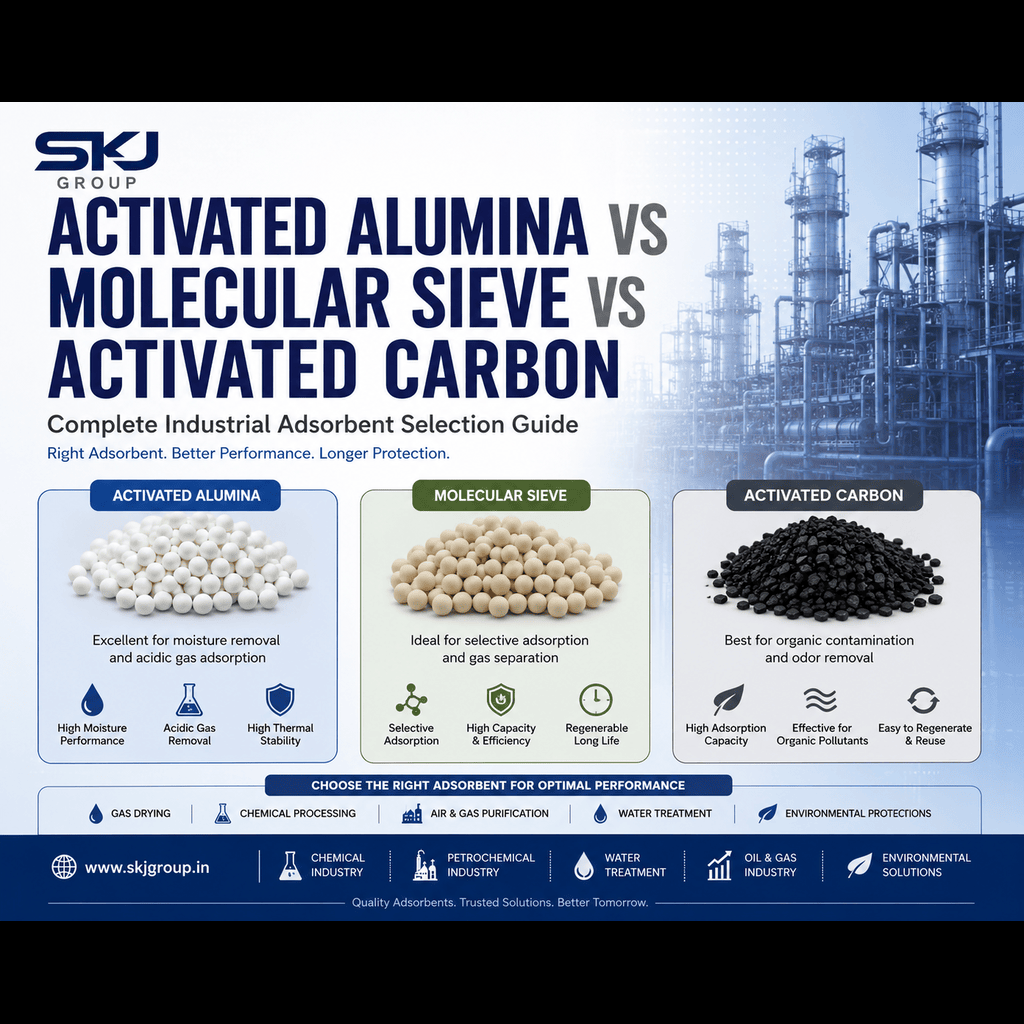
Picking the wrong adsorbent can quietly cost you thousands in downtime, poor drying performance, or contaminated output. If you’ve ever wondered why one plant swears by molecular sieves while another relies entirely on activated carbon, the answer comes down to what each adsorbent is actually built to remove. At SKJ Group, we get this question from plant engineers often, and the short answer is that no single adsorbent does everything well.
This guide breaks down activated alumina, molecular sieves, and activated carbon so you can match the right one to your process instead of guessing.
Why Adsorbent Selection Isn’t One-Size-Fits-All
Every adsorbent works by attracting and holding specific molecules onto its surface, but the way each one does this differs a lot. Some are built for moisture removal, others for gas separation, and others for pulling out organic contaminants. Choosing the wrong one usually shows up as one of these problems:
- Poor drying or dehydration performance
- Shorter adsorbent life and frequent replacement
- Contaminants passing through unfiltered
- Higher energy costs from inefficient regeneration
Let’s look at how each option performs and where it fits best.
Activated Alumina: Reliable Moisture and Fluoride Removal
Activated alumina is a porous form of aluminum oxide known for its strong affinity for water molecules. It’s one of the most commonly used desiccants in industrial drying applications, especially where deep dehydration is needed.
Where activated alumina performs best:
- Removing moisture from compressed air and process gases
- Drying natural gas before transport or storage
- Fluoride and arsenic removal in water treatment
- Catalyst support in petrochemical processes
One thing that often gets overlooked is consistency in bead quality. Working with a dependable activated alumina balls manufacturer matters because uniform bead size and hardness directly affect how well the packed bed performs and how long it lasts before attrition becomes a problem.
The main limitation is that activated alumina isn’t ideal for adsorbing organic compounds or gases other than moisture, so it’s usually paired with other adsorbents in multi-stage systems rather than used alone.
Molecular Sieves: Precision Separation at the Molecular Level
Molecular sieves are synthetic zeolites with a uniform pore structure that allows them to separate molecules based on size and polarity. This precision is what sets them apart from other adsorbents, which tend to adsorb more broadly.
Common applications of molecular sieves:
- Deep drying of gases and liquids to very low moisture levels
- Separating oxygen and nitrogen in air separation units
- Removing CO2 and sulfur compounds from natural gas
- Ethanol dehydration in fuel and beverage industries
The 13X type is particularly popular for its larger pore size, which makes it effective for adsorbing larger molecules like CO2 and mercaptans, alongside standard moisture removal. Because pore consistency is critical for performance, sourcing from experienced 13X molecular sieve manufacturers helps ensure the sieve delivers the separation efficiency your process depends on.
Molecular sieves do cost more than other adsorbents, so they’re generally reserved for applications where precision and low residual moisture actually matter to the end product.
Activated Carbon: The Go-To for Organic Contaminant Removal
Activated carbon works differently from the other two. Instead of targeting moisture, it’s built to adsorb organic compounds, odors, and certain gases through its highly porous carbon structure. The raw material used to produce it changes its performance significantly.
Why activated carbon is widely used:
- Removing volatile organic compounds (VOCs) from air streams
- Water treatment for taste, odor, and organic contaminant removal
- Solvent recovery in industrial processes
- Gold recovery and various chemical purification steps
Carbon sourced from coconut shells is especially valued for its higher hardness and micropore volume compared to coal or wood-based carbon, which means better adsorption capacity and longer service life. Choosing a reliable Coconut Shell Based Granular Activated Carbon manufacturer makes a real difference here, since raw material quality and activation process directly affect how much contaminant the carbon can actually hold before it needs replacing.
The tradeoff is that activated carbon isn’t effective for moisture removal, so it’s rarely used where dehydration is the primary goal.
Quick Comparison
| Factor | Activated Alumina | Molecular Sieve | Activated Carbon |
| Primary use | Moisture removal | Precision drying and gas separation | Organic contaminant removal |
| Pore structure | Amorphous, porous | Uniform crystalline pores | Highly microporous |
| Best for | Compressed air, water treatment | Deep drying, air separation | VOCs, odor, water purification |
| Regeneration | Easy, thermal | Thermal, needs controlled heat | Thermal or steam |
| Cost | Moderate | Higher | Moderate to low |
How to Choose the Right Adsorbent for Your Process
Ask yourself these questions before deciding:
- Is your main goal moisture removal, gas separation, or organic contaminant removal?
- How low does the residual moisture or contaminant level need to go?
- What’s your regeneration setup, and how often can you cycle the adsorbent?
- Are you dealing with a single contaminant or a mix that needs multiple adsorption stages?
For general drying duties, activated alumina remains a dependable and cost-effective option. Where precision separation or ultra-low moisture is required, molecular sieves are usually the better fit. And when the goal is removing organics, odors, or contaminants rather than moisture, activated carbon is the clear choice.
If you’re still evaluating adsorbent options, explore why activated alumina balls are widely used in industrial air drying systems and how they help maintain consistent moisture control.
Frequently Asked Questions
1. What is the difference between activated alumina and molecular sieves?
Activated alumina is mainly used for general moisture removal, while molecular sieves offer more precise separation based on molecule size, making them better suited for deep drying and gas separation.
2. Can activated carbon remove moisture from gases?
Not effectively. Activated carbon is designed to adsorb organic compounds and odors, not water molecules, so it’s typically paired with a drying agent when moisture removal is also needed.
3. Why is coconut shell activated carbon preferred over other types?
Coconut shell based carbon generally has higher hardness and a finer micropore structure, which gives it better adsorption capacity and longer operational life compared to coal or wood-based carbon.
4. What does 13X molecular sieve mean?
13X refers to a specific pore size and structure within the molecular sieve family, known for its larger pore openings that make it effective for adsorbing bigger molecules like CO2 and sulfur compounds.
5. How often do adsorbents need to be replaced?
It depends on the adsorbent type, contaminant load, and regeneration cycle, but most industrial adsorbents last from one to several years before replacement becomes necessary.
Final Thoughts
There’s no single best absorbent for every application. The right choice depends on whether your process needs moisture removal, precision gas separation, or organic contaminant control. As an experienced activated alumina balls manufacturer and Coconut Shell Based Granular Activated Carbon manufacturer, SKJ Group can help you evaluate your process requirements and recommend the adsorbent that fits your actual operating conditions.
Get in touch with the SKJ Group team today to find the right adsorbent solution for your industrial process.