Pelletized vs Granular Activated Carbon: When Should You Use Each?

Ceramic Super Intalox Saddles vs Ceramic Saddles: Which Should You Choose?
September 10, 2026
Plastic Corrugated Plate Packing vs Random Packing: Key Differences, Uses and Selection Guide
September 16, 2026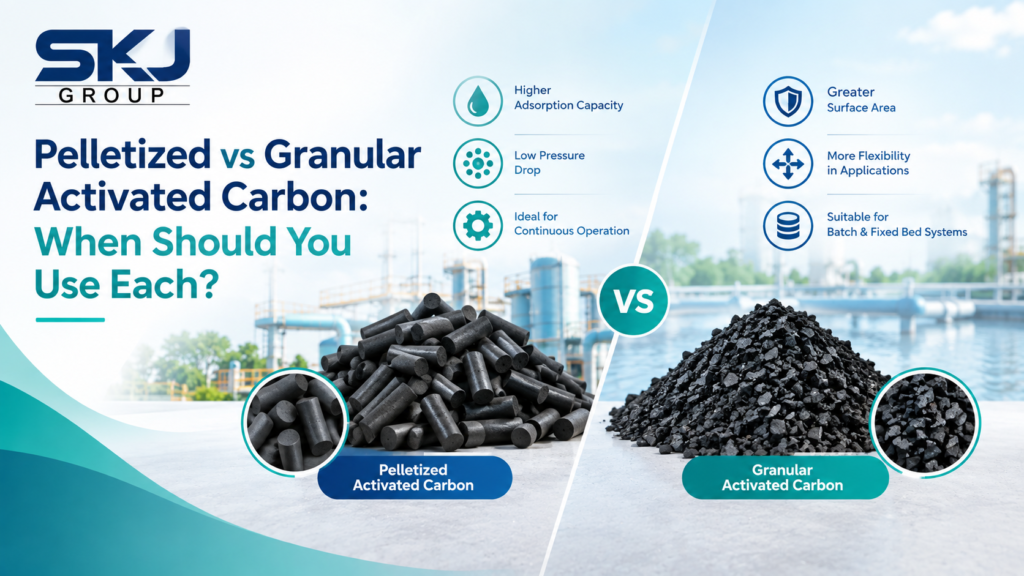
Pelletized activated carbon works best in gas-phase applications like VOC and odor control, while granular activated carbon is the better choice for liquid-phase treatment like water purification. The difference comes down to shape and density. Pellets are extruded into uniform cylinders that let gas pass through evenly with low pressure drop, while granular carbon has irregular particle sizes suited to how liquids move through a filter bed. Picking the wrong one for your application wastes carbon capacity and drives up replacement costs faster than it should.
Why Shape Actually Matters Here
It’s easy to assume all activated carbon works the same once it’s inside a filter housing. It doesn’t. The physical form of the carbon changes how gas or liquid moves through the bed, and that directly affects performance.
- Uniform shape in pellets means consistent, predictable channels for gas to flow through
- Irregular shape in granular carbon creates more surface contact points, useful for liquid treatment
- Lower dust generation in pellets, since there are no sharp broken edges
- Higher hardness in pellets, industry testing consistently shows pellet strength exceeding standard granular hardness benchmarks, which matters in systems with vibration or repeated regeneration cycles
Once you see the shape difference, the rest of the comparison follows logically.
➜ Not sure which form suits your system? Get a technical recommendation from our team
Side-by-Side Comparison
| Factor | Pelletized Activated Carbon | Granular Activated Carbon |
| Best suited to | Gas-phase, air and VOC treatment | Liquid-phase, water treatment |
| Particle shape | Uniform cylindrical | Irregular, crushed |
| Pressure drop | Lower and more consistent | Higher, varies with packing |
| Dust generation | Minimal | Higher |
| Hardness | Higher, resists attrition | Moderate |
| Common sizes | 4mm, 6mm | 8×30, 12×40 mesh grades |
| Typical cost | Slightly higher per kg | Slightly lower per kg |
Where Pelletized Carbon Wins
Gas-phase applications reward the uniform structure pellets bring to a filter bed.
- VOC and odor control. Industrial exhaust streams need consistent airflow through the media bed, and pellet shape delivers that without the pressure spikes irregular granules can cause.
- Solvent recovery. Recovery systems run continuously, and pellet hardness holds up better across repeated adsorption and regeneration cycles than granular carbon does.
- Automotive carbon canisters. Fuel vapor recovery systems specifically use pellets because of their low dust output and consistent flow characteristics in a compact housing.
- Gas mask and respirator cartridges. Predictable airflow resistance is critical here, and pellet uniformity delivers that consistency batch after batch.
If your process moves air or gas through the carbon bed, pellets are almost always the right starting point.
Where Granular Carbon Wins
Liquid treatment plays to granular carbon’s strengths in a way pellet shape can’t match.
- Drinking water treatment. The irregular surface area of granular carbon gives more contact points for organic compounds and chlorine byproducts dissolved in water.
- Wastewater polishing. Municipal and industrial wastewater lines commonly use granular beds because they handle variable flow rates without the tight tolerances pellet beds need.
- Decolorization in food and beverage processing. Granular carbon’s higher surface area per unit cost makes it the practical choice for bulk liquid clarification.
- General industrial liquid filtration. Where cost per kg matters more than airflow precision, granular carbon usually wins on price.
A Quick Way to Decide
Ask yourself one question first: is the stream a gas or a liquid?
- Gas or vapor stream → start with pelletized activated carbon
- Liquid stream → start with granular activated carbon
- Mixed or unusual application → check pressure drop tolerance and dust sensitivity, since these often settle the decision even when the first question doesn’t
Most buyers overthink this decision. In practice, the phase of the stream you’re treating answers it about 90 percent of the time.
What to Check Before You Order
Not every batch of carbon performs the same, regardless of which form you choose.
- Iodine number, which indicates adsorption capacity, not just particle size, industry-grade carbon typically runs from 900 to over 1000 mg/g depending on application
- Hardness number, especially important for pellets in vibrating or high-flow systems
- Ash content, since higher ash reduces effective adsorption capacity
- Moisture content at delivery, which affects both weight-based pricing and immediate performance
- Consistent pellet diameter or mesh grading, so pressure drop stays predictable across the full bed
A dependable supplier will share this data without being asked twice. If a quote comes back with only a price and no technical specification sheet, that’s worth treating as a warning sign before committing to volume.
For plants comparing this against a completely different carbon source, our guide on what actually determines coal-based activated carbon pricing breaks down the cost factors worth checking regardless of which form you land on.
Working With Pellets Activated Carbon Manufacturers
Sourcing from established Pellets activated carbon manufacturers rather than a trader matters more than most buyers realize. Manufacturers control the extrusion and activation process directly, which means batch-to-batch consistency in hardness and pore structure. Traders reselling mixed-source carbon often can’t answer basic questions about which raw material or activation method produced what’s in the bag.
When comparing quotes from different Pellets activated carbon suppliers, ask for the iodine number and hardness figures side by side rather than comparing price per kg in isolation. A cheaper pellet with lower hardness breaks down faster, generates more dust, and needs replacing sooner, which erases the upfront saving within a few months of continuous operation.
For buyers sourcing internationally, working with Pellets activated carbon exporters who provide full documentation, certificates of analysis, packing lists, and consistent container loading, saves real time at customs and reduces the chance of a rejected shipment on arrival.
Frequently Asked Questions
1. What is the main difference between pelletized and granular activated carbon?
Pelletized carbon is extruded into uniform cylinders suited to gas-phase applications, while granular carbon has irregular particle sizes better suited to liquid-phase treatment like water purification.
2. Which type of activated carbon has lower pressure drop?
Pelletized activated carbon has lower and more consistent pressure drop because its uniform shape creates predictable flow channels for gas to pass through.
3. Can pelletized activated carbon be used for water treatment?
It’s technically possible, but granular carbon is generally more cost-effective and better suited for liquid-phase treatment due to its higher surface contact area.
4. Is pelletized activated carbon more expensive than granular?
Pelletized carbon typically costs slightly more per kilogram due to the extrusion process, but its lower dust generation and higher hardness often offset that cost in continuous gas-phase applications.
5. How do I know which carbon size is right for my system?
Match the carbon form to your stream type first, gas or liquid, then confirm sizing against your housing’s flow rate and required contact time with your supplier.
6. Does pelletized activated carbon generate less waste than granular?
Yes. Its lower dust generation means less fine carbon lost during handling and operation, which reduces both material waste and the risk of dust escaping into downstream equipment.
Get the Right Carbon for Your Application
Choosing the wrong carbon form costs more in downtime and reduced adsorption capacity than the small price difference between pellet and granular grades. If you’re specifying carbon for a new system or replacing an underperforming media bed, SKJ Group can help match the right form and grade to your actual process stream.
➜ Request a Quote and Technical Datasheet and our team will walk you through options suited to your application.