Ceramic Super Intalox Saddles vs Ceramic Saddles: Which Should You Choose?

Coal-Based Activated Carbon Price in India: What Determines Cost for Industrial Buyers?
September 5, 2026
Pelletized vs Granular Activated Carbon: When Should You Use Each?
September 13, 2026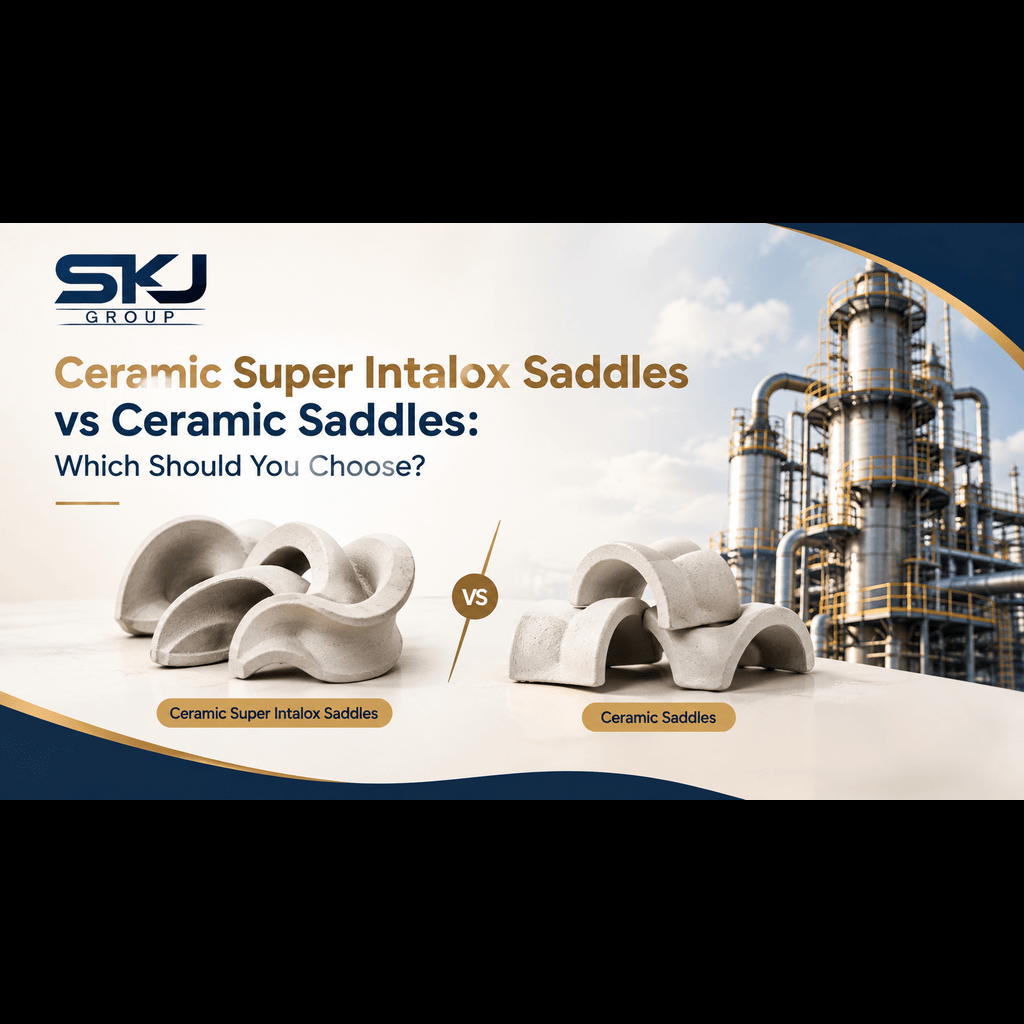
Choose standard ceramic saddles for general-purpose distillation and absorption where cost matters most, and choose Ceramic Super Intalox Saddles when your column needs higher capacity, lower pressure drop, or better efficiency in the same tower volume. Both are ceramic random packing shapes, but the geometry difference changes how much liquid and gas contact you get per cubic meter of packed bed. Picking the wrong one means either overspending on performance you don’t need, or underperforming in a column that needed more surface area.
Get this call wrong and you either pay for capability your process will never use, or you spend the next two years fighting a bottleneck that better packing would have solved on day one. This guide compares both shapes on the factors that actually matter to a plant engineer, so you can make the call with confidence instead of guessing from a catalog sheet.
Quick Comparison: Key Differences
| Factor | Ceramic Saddles | Ceramic Super Intalox Saddles |
| Surface area | Lower, standard curved design | Higher, refined rib geometry |
| Pressure drop | Moderate | Lower for the same load |
| Flooding capacity | Standard | Higher, handles more throughput |
| Upfront cost | Lower per kg | Higher per kg |
| Best fit | General water treatment, basic scrubbing | Distillation, acid absorption, retrofits, high-load columns |
What Makes These Two Shapes Different
A standard ceramic saddle, often called a Berl saddle, has a simple curved shape that has been used in packed columns for decades. It works reliably, distributes flow evenly, and is inexpensive to manufacture at scale.
Ceramic Super Intalox Saddles take that basic curved design and refine the geometry further. The shape includes additional ribs and a more open structure that increases surface area without adding excessive weight or restricting flow. This is why they are often positioned as the next step up from standard saddle packing in demanding applications.
Quick pointers on the core difference:
- Standard saddles use a simple, proven curved shape
- Super Intalox saddles use a refined shape with more surface area per unit volume
- Both are random packing, meaning they are dumped into the column rather than stacked in a fixed pattern
- The performance gap grows wider as column diameter and throughput increase
Surface Area and Mass Transfer Efficiency
Surface area is the single biggest factor separating these two products. More surface area means more contact between the gas and liquid phases, which translates directly into better mass transfer.
Ceramic Super Intalox Saddles typically offer a noticeably higher specific surface area compared to standard saddles of the same nominal size. In practical terms, that means a column packed with Super Intalox saddles can often achieve the same separation efficiency with a shorter packed bed height, or better separation in the same height. For processes like acid absorption, gas scrubbing, or fine distillation where every stage of contact counts, this difference shows up in your product purity and recovery numbers.
Pressure Drop and Flow Capacity
Pressure drop is where the newer geometry earns its reputation. The open structure of Super Intalox saddles allows gas and liquid to move through the bed with less resistance than a standard saddle shape carrying the same load.
Why lower pressure drop matters in real operations:
- Less energy needed to push gas through the column, which lowers utility costs
- Higher flooding point, so the column can handle more throughput before performance drops
- Reduced strain on blowers and compressors over the long run
- More stable operation during load swings or startup conditions
If your plant is running close to its flooding limit or looking to increase capacity without installing a bigger column, this is usually the deciding factor in favor of the Super Intalox shape.
Cost Comparison: Upfront Price vs Long-Term Value
Standard ceramic saddles cost less per kilogram to manufacture and buy, which makes them the practical choice for lower-demand applications like general water treatment, basic scrubbing, or non-critical process columns. As a Ceramic Saddles Manufacturer, SKJ Group keeps pricing on these standard shapes competitive precisely because so many plants rely on them for everyday runs. If your separation requirement is modest, spending extra on advanced geometry adds cost without adding real benefit.
Ceramic Super Intalox Saddles cost more upfront, but the total cost picture often flips once you factor in column size, energy use, and separation performance over the plant’s operating life. A smaller column packed with Super Intalox saddles can sometimes match the output of a larger column filled with standard saddles, which affects everything from civil foundation cost to piping and instrumentation.
A simple way to think about it:
- Choose standard saddles when budget is tight and process demands are moderate
- Choose Super Intalox saddles when energy savings, capacity, or column footprint reduction justify the premium
- Always compare cost per unit of separation achieved, not just cost per kilogram of packing
Chemical Resistance and Durability
Both products are typically manufactured from the same grade of chemically resistant ceramic, so resistance to acids, alkalis, and high temperatures is comparable between the two shapes. The durability difference mostly comes down to wall thickness and rib design rather than the base material.
Pointers on handling and service life:
- Both shapes resist attrition well when installed and loaded correctly
- Super Intalox saddles’ more intricate geometry means slightly more careful handling during loading to avoid chipping
- Standard saddles are more forgiving during rough handling or manual loading
- Service life for both types generally exceeds a decade under normal operating conditions
Where Each Shape Fits Best
Ceramic saddles work well for:
- General water and wastewater treatment towers
- Basic gas scrubbing where separation demands are moderate
- Cost-sensitive projects with straightforward process conditions
- Applications where column diameter and height are not tightly constrained
Ceramic Super Intalox Saddles work well for:
- Distillation columns needing higher theoretical stages per meter of packing
- Acid plants and absorption towers where pressure drop directly affects energy cost
- Retrofits where a plant wants more capacity without rebuilding the column
- Processes running close to flooding limits during peak load
How to Decide for Your Column
Start with your process data rather than the price sheet. Ask yourself three questions before you look at a single quotation:
- Is your separation efficiency under pressure? If you’re struggling to hit product purity or recovery targets, more surface area usually closes that gap faster than adding column height.
- Is pressure drop eating into your energy budget? Rising utility costs on blowers or compressors is a strong signal the open Super Intalox geometry will pay for itself.
- Is your column capacity-constrained? If you’re near the flooding limit and can’t justify a bigger column, Super Intalox saddles buy you headroom without a rebuild.
If any of those three questions got a yes, the Super Intalox shape usually earns its premium. If your process runs comfortably within its limits and the priority is cost control, standard saddles remain a dependable, no-fuss choice.
If you want a broader view before deciding, our earlier post on the difference between ceramic saddles, pall rings, and Intalox saddles covers how these shapes stack up against ring-type packing as well, which is useful if you’re still comparing packing families rather than just saddle types.
SKJ Group produces both shapes to the same quality standards as a working Ceramic Super Intalox Saddle Manufacturer, so the choice really comes down to your process rather than which supplier makes a better version of one over the other. Our team regularly helps plants run the numbers on both options before committing to a packing order.
Frequently Asked Question
1. What is the main difference between ceramic saddles and Ceramic Super Intalox Saddles?
The core difference is surface area and pressure drop. Super Intalox saddles have a more refined geometry that packs in more surface area per unit volume while keeping pressure drop lower, which improves mass transfer efficiency compared to standard saddles.
2. Are Ceramic Super Intalox Saddles worth the extra cost?
It depends on your process. If your column needs higher capacity, better separation, or lower energy consumption, the performance gain usually justifies the higher price. For general-purpose or low-demand applications, standard ceramic saddles are often sufficient.
3. Can Ceramic Super Intalox Saddles replace standard saddles in an existing column without modification?
In most cases, yes, since both are random packing and load into the column the same way. However, it’s worth checking your column’s flooding curve and support plate rating before switching, since capacity and pressure drop characteristics differ.
4. Which packing type is better for high-temperature or corrosive applications?
Both perform similarly in chemical and thermal resistance, since they are typically made from the same ceramic material grade. The choice between them should be based on mass transfer and pressure drop needs rather than chemical resistance alone.
5. Do ceramic saddles or Super Intalox saddles have a longer service life?
Both typically offer a long service life exceeding a decade under normal operating conditions. Service life depends more on installation care, loading method, and operating conditions than on which saddle shape is used.
6. Is ceramic saddle tower packing suitable for water treatment applications?
Yes, ceramic saddles tower packing is widely used in water and wastewater treatment towers because it offers reliable flow distribution and chemical resistance at a lower cost than more advanced packing shapes, which fits the moderate separation demands of most treatment processes.
Talk to Our Team Before You Order
Choosing between these two saddle types is easier with actual process numbers in front of you, not just a spec comparison. If you’re evaluating super intalox saddles for an upcoming column or retrofit, our Mandsaur team can review your throughput, pressure drop targets, and separation requirements before you place an order. Get in touch with SKJ Group for a technical recommendation and quotation tailored to your process.