Wire Gauze Structure Explained: Strong & Durable Design

Best Materials for Heat Transfer: Complete Expert Guide
October 8, 2025
High-Efficiency Thermal Storage RTO RCO Ceramic Honeycomb
October 15, 2025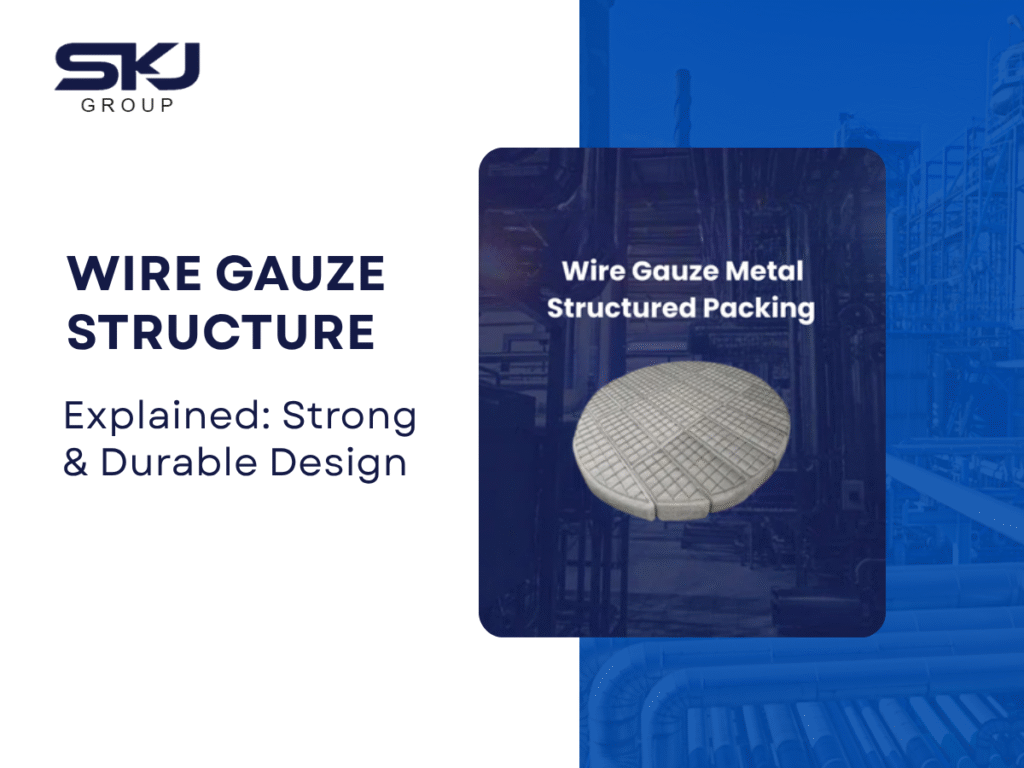
The structure of wire gauze is a square sheet of metal wire woven in an over-and-under pattern, usually iron or steel, with a ceramic centre in the common lab version. The woven mesh spreads flame heat across the base of a beaker, and the ceramic centre makes that spread more even. Industrial plants use the same idea in finer stainless steel mesh, crimped into corrugated sheets and stacked as metal wire gauze packing inside distillation columns.
Below, we break down the parts, the weave types and the difference between lab gauze and industrial gauze packing.
At a glance
- Mesh: Metal wire woven in a crisscross pattern
- Centre: A ceramic disc on most lab gauze, which spreads heat more evenly
- Edges: Turned inward so the mesh does not fray
- Metals: Iron, steel, copper or nichrome for lab gauze, stainless steel for industrial packing
- Job: Spread heat in the lab, spread liquid inside a column
What Is Wire Gauze?
Wire gauze is a mesh-like material made from interwoven metal wires, typically stainless steel, copper, or iron. It is widely used in laboratories, chemical towers, and industrial packing due to its ability to distribute heat evenly and provide support in chemical reactions or distillation columns.
The strength of wire gauze comes from its structured weaving pattern, which makes it durable, flexible, and resistant to corrosion.
Structure of Wire Gauze: The Four Parts
- Woven mesh. Wires cross over and under each other. The mesh count is the number of openings per inch. A finer mesh spreads heat more smoothly, and a coarser mesh lets more air through.
- Ceramic centre. A round disc in the middle spreads heat more evenly than plain mesh. It is pressed into the wire so it does not peel. Older gauzes used asbestos here, so check any old stock.
- Turned edges. The edges fold inward to stop fraying and sharp wire ends.
- Metal. Iron and steel are common. Copper conducts heat well, and nichrome lasts longer and resists tearing.
Lab gauze usually comes in 4, 5 or 6 inch squares, so it fits different flasks and beakers.
What Does Wire Gauze Do in a Lab?
- Spreads heat: The metal carries heat across the sheet, so the base of the beaker heats evenly
- Protects glass: The flame never touches the flask
- Supports the vessel: It holds glassware steady on the tripod
Types of Wire Gauze Weave
- Plain weave: Over one wire, under one. Stable and even, and the usual choice for general use
- Twill weave: Over two, under two. It handles heavier wire and suits tougher duty
- Dutch weave: Fine wires packed tightly against thicker ones. It is made for filtering, not for flame heating
- Ceramic-centre gauze: Plain mesh plus a ceramic disc, made for heating glassware over a flame
Lab Gauze vs Industrial Gauze Packing
| Lab wire gauze | Industrial gauze packing | |
| Shape | Flat square, about 100 to 150 mm | Corrugated sheets stacked into blocks that fit the column |
| Typical metal | Iron or steel, sometimes copper or nichrome | Stainless steel, such as 304 or 316 grades |
| Centre | Ceramic disc on most types | None, fine mesh throughout |
| Job | Spread flame heat under glassware | Spread liquid in thin films for gas and liquid contact |
| Surface area | Not a design factor | About 250 to 750 m²/m³ for common types |
| Where it works | School, college and test labs | Vacuum distillation and fine chemical columns |
So the same woven idea does two very different jobs. In a lab, it protects glass. In a column, it creates surface area.
How Is Metal Wire Gauze Packing Built?
Industrial gauze packing keeps the woven mesh but changes the shape.
- Corrugated sheets: Fine mesh is pressed into waves that run at an angle, often 45 or 60 degrees
- Opposite slopes: Neighbouring sheets slope the other way, which forms crossing flow channels
- Rotated layers: Each layer sits 90 degrees from the last, so gas and liquid keep mixing
- Capillary action: The fine mesh pulls liquid into thin films, even at very low flow rates
This is why gauze packing gives very high surface area and low pressure drop. Common types are rated at roughly 250 m²/m³ (AX), 500 m²/m³ (BX) and 700 to 750 m²/m³ (CY). These are typical published values, and they vary by maker.
Where it fits: vacuum distillation of heat-sensitive products, fine chemicals and hard separations.
Where it does not: fouling services and strongly corrosive media, because fine mesh blocks and wears easily.
Need gauze packing for a vacuum column? Share your column size, operating pressure and fluid, and our team will suggest a type and size.
For a deeper look at selection and performance, read our complete guide to metal wire gauze structured packing.
What to Check Before You Buy
A good metal wire gauze packing manufacturer will answer these with data, not claims:
- Steel grade: 304, 304L, 316 or 316L, matched to your fluid
- Wire diameter and mesh count: They set strength and surface area
- Type and surface area: AX, BX, CY or an equivalent, in m²/m³
- Corrugation angle: It affects flow and pressure drop
- Fit to your column: Element size and diameter for your tower
- Performance data: Pressure drop and efficiency for a similar system
- A drawing or sample before a large order
At SKJ Group, we make metal wire gauze packing in Mandsaur for vacuum and atmospheric distillation, absorption and stripping columns. Ask us for the steel grade certificate, wire and mesh details and the surface area for your model, and we will share them before you order.
If you are comparing metal wire gauze packing suppliers, send us your column size, pressure and fluid, and we will suggest a type.
Supply for Indian and Overseas Buyers
Buying from outside India? Send your element size, quantity and destination, and we will confirm packing and documents before you commit.
Structure of Wire Gauze FAQs
1. What is the structure of wire gauze?
It is a crisscross weave of metal wire with turned edges, and a ceramic centre on most lab versions. The weave spreads heat evenly across the glassware.
2. What is the ceramic centre of wire gauze for?
It spreads heat more evenly than plain mesh, so a flask does not get hot spots. It also protects glass from direct flame.
3. Why is wire gauze used with a Bunsen burner?
Glass can crack under a direct flame. The gauze diffuses the heat and lets the glassware heat more gently.
4. What metals are used for wire gauze?
Iron and steel are the most common for lab gauze. Copper and nichrome are also used. Industrial gauze packing is usually stainless steel.
5. What is metal wire gauze packing?
It is a fine metal mesh pressed into corrugated sheets and stacked inside a column. It gives high surface area with low pressure drop for distillation and absorption.
6. What is wire gauze packing used for?
Mainly vacuum distillation of heat-sensitive products, fine chemicals and hard separations. It works best at low liquid rates.
7. Can gauze packing handle dirty or corrosive fluids?
Not well. Fine mesh blocks easily with solids, and strongly corrosive media wear it out. For those duties, ceramic or heavier metal packing is usually a better choice.
8. Where can I find metal wire gauze packing in Mandsaur?
SKJ Group supplies metal wire gauze structured packing from Mandsaur, Madhya Pradesh. Find the metal wire gauze packing in Mandsaur listing on our map, or send us your column details.
Final Thoughts
Wire gauze looks simple, but its structure does real work. In a lab, the weave and the ceramic centre spread heat. In a column, the corrugated mesh spreads liquid. Match the type to the job, and ask for real data before you order.
Ready to choose the right packing? Share your column details and get specs and lead times from our team.