The Importance of 4A Molecular Sieve in Gas Dehydration Plants

Advanced Gas Processing Applications of 13X APG Zeolite Molecular Sieve
February 21, 2026
Applications of 13X-HP Molecular Sieve in High-Pressure Gas Plants
February 25, 2026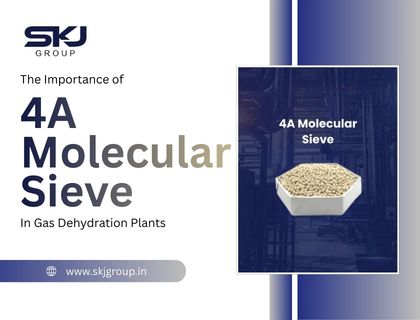
Natural gas processing and industrial gas production require efficient moisture removal to prevent corrosion, hydrate formation, and equipment damage. 4A molecular sieve has become the workhorse adsorbent for gas dehydration applications worldwide, delivering reliable performance in removing water from gas streams while maintaining operational efficiency. As a leading 4A molecular sieve manufacturer, SJK India recognizes the critical role this versatile adsorbent plays in ensuring gas quality and protecting downstream equipment in processing facilities.
4A molecular sieve for gas dehydration plants provides exceptional water adsorption capacity while excluding most hydrocarbon molecules from its pore structure. This selective adsorption characteristic makes 4A zeolite molecular sieve the preferred choice for natural gas drying, instrument air systems, and various industrial gas treatment applications requiring deep moisture removal.
Understanding 4A Molecular Sieve Technology
4A zeolite molecular sieve belongs to the Linde Type A (LTA) crystal structure family with sodium cations providing charge balance in the aluminosilicate framework. The designation “4A” indicates the effective pore opening of approximately 4 angstroms (0.4 nanometers), created through the specific sodium cation exchange during manufacturing.
This precisely controlled pore size enables 4A molecular sieve to adsorb water (kinetic diameter 2.8Å), methanol (3.6Å), hydrogen sulfide (3.6Å), carbon dioxide (3.3Å), and ammonia (2.6Å) while excluding larger molecules including ethane (4.4Å) and higher hydrocarbons. The size selectivity proves essential in gas dehydration technology where water removal without significant hydrocarbon co-adsorption optimizes process efficiency.
The crystalline structure provides extensive internal surface area exceeding 700 m²/g, creating enormous adsorptive capacity within the uniform pore network. Industrial desiccant beads manufactured from 4A zeolite achieve static water capacities exceeding 22 wt% under standard test conditions, significantly higher than traditional desiccants like silica gel or activated alumina.
Critical Applications in Gas Dehydration
1. Natural Gas Processing and Pipeline Drying
4A molecular sieve for gas dehydration plants represents the industry standard for natural gas dehydration protecting pipelines and processing equipment from water-related problems. Raw natural gas emerges from wells saturated with water vapor requiring removal to prevent corrosion, hydrate formation, and liquid accumulation in pipelines.
Industrial application of 4A zeolite in gas treatment systems typically employs multiple-bed regenerative designs where one or more beds adsorb moisture while others undergo regeneration. This continuous operation enables processing facilities to maintain uninterrupted gas flow while achieving stringent moisture specifications.
Natural gas transmission specifications commonly require water content below 7 pounds per million standard cubic feet (approximately -20°C dew point) to prevent hydrate formation. Best molecular sieve for removing moisture from gas streams technology routinely achieves dew points of -40°C to -70°C, providing substantial safety margins against specification violations.
LNG production demands even more rigorous dehydration, with water content requirements below 0.1 ppm to prevent ice formation in cryogenic heat exchangers. 4A zeolite molecular sieve delivers the deep dehydration capability these demanding applications require.
2. Instrument Air and Plant Air Drying
Manufacturing facilities, refineries, and chemical plants consume large volumes of instrument air for pneumatic controls, analyzers, and process equipment. Pressure swing adsorption (PSA) dryers utilizing 4A molecular sieve provide reliable moisture control protecting sensitive instruments from condensation damage.
Moisture removal from gas streams in instrument air systems prevents freezing in outdoor pneumatic lines, corrosion of control valves, and analyzer drift from water interference. 4A molecular sieve in PSA gas dehydration units achieves pressure dew points of -40°C to -70°C ensuring trouble-free operation across temperature extremes.
The rapid adsorption kinetics of 4A zeolite molecular sieve enable short cycle times in PSA dryers, minimizing equipment size and capital costs. Modern heatless dryers regenerate adsorbent beds using 10-15% of dried product air, making them economical for moderate to large compressed air systems.
3. Refrigerant and Chemical Processing
Refrigeration systems require rigorous moisture control preventing ice formation in expansion valves and avoiding hydrolysis of refrigerant compounds. Industrial desiccant beads of 4A molecular sieve installed in refrigerant circuits provide permanent moisture protection without requiring replacement.
Chemical processing applications including solvent drying, feedstock purification, and product dehydration employ 4A zeolite molecular sieve for its combination of capacity, selectivity, and thermal stability.
Case Study: Natural Gas Processing Facility Enhancement
A natural gas processing facility in Rajasthan handling 8 million standard cubic meters daily partnered with 4A molecular sieve in Mandsaur supplier SJK India to upgrade their gas dehydration system. The existing system struggled to consistently meet pipeline specifications during peak production periods.
Previous System Challenges:
- Inconsistent outlet dew point with specification violations
- Adsorbent capacity degradation requiring frequent replacement
- High regeneration energy consumption
- Difficulty handling feed gas composition variations
Solution Implementation:
SJK India supplied premium 4A zeolite molecular sieve with enhanced crush strength and optimized bead size distribution. The installation included 95 metric tons of fresh adsorbent across six dehydration beds with improved regeneration controls.
Performance Results:
- Consistent outlet dew point of -50°C (well below -20°C specification)
- Adsorbent service life projection exceeding 6 years versus previous 3-year cycle
- Regeneration energy reduced by 24% through improved thermal efficiency
- Successful handling of 20% throughput variations
- Annual cost savings exceeding and extended life and reduced energy
The performance improvement validated the investment in premium 4A molecular sieve from established 4A molecular sieve manufacturers.
Technical Specifications and Performance Characteristics
Quality 4A molecular sieve for gas dehydration plants meets rigorous performance specifications ensuring reliable operation. Static water capacity exceeding 22 wt% at 25°C and 4.6 torr partial pressure represents the industry benchmark, with dynamic working capacities of 10-14 wt% in typical cyclic gas dehydration service.
Bead sizes available from 4A molecular sieve suppliers include 1.6-2.5mm (8×12 mesh) for balanced pressure drop and mass transfer, 2.0-3.0mm (6×8 mesh) for lower pressure drop in high-flow applications, and 1.0-1.6mm for specialty applications requiring maximum surface area.
Crush strength exceeding 60N for individual beads ensures mechanical integrity during pressure cycling and prevents attrition that generates fines. Bulk density of 680-720 kg/m³ affects vessel sizing and adsorbent loading calculations.
The heat of adsorption for water on a 4A zeolite molecular sieve approaches 3800 kJ/kg, requiring careful thermal management during adsorption cycles. Adsorption isotherms show favorable Type I characteristics with high capacity at low partial pressures, enabling deep dehydration to parts-per-million moisture levels.
Process Design and Regeneration Considerations
Successful gas dehydration technology implementation requires careful attention to system design parameters. Temperature swing adsorption (TSA) systems heat adsorbent beds to 200-280°C using heated regeneration gas, driving off adsorbed water for venting or disposal.
Pressure swing adsorption (PSA) designs combine pressure reduction with moderate heating (120-180°C) for faster regeneration cycles. Heatless PSA dryers operate without external heating, using pressure reduction and dry product gas purging for regeneration.
Regeneration gas flow rates must provide sufficient heat input and mass transfer to completely restore adsorbent capacity within available cycle time. Cooling procedures after regeneration prove critical for optimal performance, requiring adsorbent bed temperatures below 50°C before switching to adsorption mode.
Comparison with Alternative Molecular Sieves
Understanding differences between molecular sieve types enables optimal material selection. 4A zeolite molecular sieve features 4Å pores compared to 3Å pores in 3A molecular sieve and 5Å pores in 5A variants.
The 4A pore size adsorbs water, methanol, hydrogen sulfide, and carbon dioxide while excluding ethane and larger hydrocarbons. This selectivity proves ideal for natural gas drying where hydrocarbon co-adsorption wastes capacity and complicates regeneration.
4A molecular sieve provides higher water capacity than 3A variants while maintaining hydrocarbon selectivity superior to 5A sieves that co-adsorb normal paraffins.
FAQ’s About 4A Molecular Sieve
1. What is molecular sieve 4A?
4A molecular sieve is a synthetic zeolite with 4 angstrom pore openings that selectively adsorbs water, methanol, hydrogen sulfide, and CO₂ while excluding larger molecules.
2. What is 4A zeolite used for?
4A zeolite is used for natural gas dehydration, compressed air drying, refrigerant purification, instrument air treatment, and industrial gas moisture removal applications.
3. What is the difference between 4A and 13X molecular sieve?
4A molecular sieve has 4Å pores adsorbing water and small polar molecules while excluding hydrocarbons, whereas 13X features 10Å pores adsorbing much larger molecules.
4. What is the difference between 4A and 5A zeolite?
4A zeolite has 4Å pores excluding normal paraffins and larger molecules, while 5A features 5Å pores that adsorb normal paraffins up to C10.
5. How do you activate 4A molecular sieves?
Activate 4A molecular sieves by heating to 250-300°C under vacuum or dry gas flow for 4-8 hours to remove manufacturing moisture.
6. Which is better: 5A or 13X molecular sieve?
Neither is universally better; 5A excels at normal paraffin separation, while 13X provides superior capacity for bulk CO₂, H₂S, and water removal.
7. How do you regenerate 4A molecular sieve?
Regenerate 4A molecular sieve by heating to 200-280°C with dry purge gas for several hours, cooling below 50°C, then returning to service.
Conclusion
4A molecular sieve represents essential technology for reliable gas dehydration technology across natural gas processing, industrial air systems, and specialty gas production. The combination of high water capacity, selective adsorption, and robust regenerability makes 4A zeolite molecular sieve the optimal choice for achieving deep dehydration specifications economically.
Partner with SJK India for Premium 4A Molecular Sieve
Optimize your gas dehydration operations with premium 4A molecular sieve from SJK India. As a trusted 4A molecular sieve manufacturer serving 4A molecular sieve in Mandsaur and throughout India, we deliver high-performance adsorbents engineered for demanding gas treatment applications.
Contact SJK India today and discover why leading gas processors choose us as their preferred 4A molecular sieve suppliers. Experience measurable improvements in moisture removal efficiency and operational costs.