Advanced Gas Processing Applications of 13X APG Zeolite Molecular Sieve

3A Molecular Sieve in Ethanol Dehydration Plants
February 19, 2026
The Importance of 4A Molecular Sieve in Gas Dehydration Plants
February 23, 2026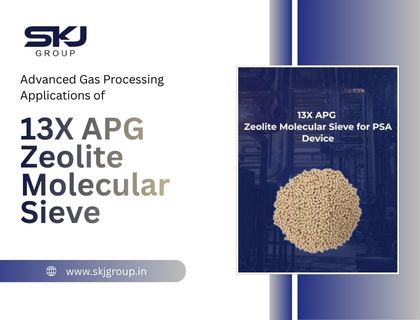
Industrial gas processing demands increasingly sophisticated separation technologies to meet stringent purity specifications while optimizing energy efficiency and operational costs. 13X APG zeolite molecular sieve for PSA device has emerged as the premier adsorbent for advanced gas purification applications, delivering superior performance in removing contaminants from natural gas, air separation, and specialty gas production. As a leading 13X APG zeolite molecular sieve for PSA device manufacturer, SJK India recognizes the transformative impact this high-capacity adsorbent delivers across diverse industrial gas processing operations.
The 13X zeolite molecular sieve represents the industry standard for applications requiring broad selectivity and high adsorption capacity for polar molecules and larger hydrocarbons. The APG molecular sieve adsorbent designation indicates Air Products Grade specifications optimized specifically for pressure swing adsorption (PSA) systems in demanding gas processing environments.
Understanding 13X APG Zeolite Molecular Sieve Technology
The 13X zeolite molecular sieve belongs to the faujasite (FAU) crystal structure family with sodium cations providing charge balance in the aluminosilicate framework. The designation “13X” refers to the effective pore opening of approximately 10 angstroms (1.0 nanometers), significantly larger than Type A molecular sieves like 3A, 4A, and 5A variants.
This large pore aperture enables 13X APG zeolite molecular sieve for advanced gas processing to adsorb molecules up to C9 aromatics, including carbon dioxide, hydrogen sulfide, mercaptans, water, and heavier hydrocarbons that smaller-pore sieves cannot accommodate. The three-dimensional pore network provides extensive internal surface area exceeding 650 m²/g, creating enormous adsorptive capacity within compact adsorbent beds.
High-capacity gas separation adsorbent formulations designated APG (Air Products Grade) feature optimized bead strength, uniform particle sizing, and controlled binder content maximizing performance in cyclic pressure swing adsorption (PSA) systems. These enhancements deliver superior attrition resistance and extended service life compared to standard molecular sieve products.
The sodium cation composition provides strong affinity for polar molecules and quadrupolar species like carbon dioxide, enabling selective removal from gas streams while less polar components pass through adsorbent beds.
Critical Applications in Gas Processing
1. Natural Gas Purification and LNG Production
13X molecular sieve for CO₂ removal in natural gas plants represents one of the largest industrial applications. Raw natural gas typically contains 2-15% carbon dioxide that must be reduced to pipeline specifications (typically 2-3%) or LNG feed requirements (under 50 ppm CO₂).
High capacity 13X zeolite for LNG gas purification enables simultaneous removal of water, carbon dioxide, hydrogen sulfide, and mercury in integrated dehydration and sweetening units. This multi-contaminant removal capability reduces equipment requirements and capital costs compared to separate treatment systems.
The deep CO₂ removal capability of 13X APG zeolite molecular sieve for PSA device proves essential for LNG production where residual carbon dioxide freezes at cryogenic temperatures, blocking heat exchangers and causing operational disruptions. Advanced pressure swing adsorption (PSA) systems utilizing 13X APG achieve CO₂ levels below 10 ppm meeting stringent LNG specifications.
Natural gas processing facilities worldwide rely on the best 13X molecular sieve for industrial gas drying and purification to achieve pipeline quality while maximizing methane recovery. The high working capacity enables smaller adsorbent beds and reduced regeneration energy compared to alternative purification technologies.
2. Air Separation and Nitrogen Generation
Industrial application of 13X APG in PSA gas separation systems for nitrogen production represents a major market segment. On-site nitrogen generators serving pharmaceutical, food processing, electronics, and chemical manufacturing employ 13X zeolite molecular sieve to selectively adsorb oxygen, water, and carbon dioxide from compressed air streams.
The resulting product nitrogen purity ranges from 95% to 99.999% depending on application requirements and PSA system design. 13X APG zeolite molecular sieve for advanced gas processing delivers the high oxygen capacity and rapid adsorption kinetics essential for efficient nitrogen generation.
Medical oxygen concentrators increasingly utilize 13X APG molecular sieve adsorbent formulations optimized for PSA applications requiring compact footprints and reliable performance. The selective nitrogen adsorption produces oxygen-enriched product gas meeting medical purity specifications.
3. Hydrogen Purification and Recovery
Petroleum refineries and ammonia production facilities generate hydrogen-rich streams contaminated with carbon dioxide, carbon monoxide, methane, and nitrogen requiring purification. Pressure swing adsorption (PSA) systems employing 13X zeolite molecular sieve achieve hydrogen purities exceeding 99.99% while recovering 85-95% of feed hydrogen.
The layered bed designs common in hydrogen PSA units utilize 13X APG zeolite molecular sieve for PSA device in combination with activated alumina and other adsorbents, each removing specific impurities. The 13X layer provides final polishing removing trace CO₂ and moisture ensuring hydrogen product specifications.
Fuel cell applications demanding ultra-high purity hydrogen (99.999%+) rely on high-capacity gas separation adsorbent technology achieving parts-per-million impurity levels.
Case Study: Natural Gas Processing Facility Optimization
A major natural gas processing plant in Gujarat handling 10 million standard cubic meters daily partnered with 13X APG zeolite molecular sieve for PSA device suppliers SJK India to upgrade their CO₂ removal system. The facility processed raw gas containing 8% CO₂ requiring reduction to 2% for pipeline injection.
Previous System Challenges:
- Inconsistent CO₂ removal with frequent specification violations
- High regeneration energy consumption impacting operating economics
- Short adsorbent life requiring replacement every 3-4 years
- Limited throughput capacity constraining production growth
Solution Implementation:
SJK India supplied premium 13X APG zeolite molecular sieve for advanced gas processing with enhanced crush strength and optimized pore structure. The installation included 180 metric tons of adsorbent across twelve PSA beds with upgraded process controls.
Performance Results:
- Consistent product CO₂ levels of 1.8% (10% below specification)
- Regeneration energy reduced by 26% through improved cycle design
- Adsorbent service life projection exceeding 7 years
- Throughput capacity increased 18% enabling additional production
- Annual operating cost savings exceeding ₹2.8 crores
The performance improvement validated the investment in premium 13X APG zeolite molecular sieve for PSA device in India products from established 13X APG zeolite molecular sieve for PSA device manufacturers.
Technical Specifications and Selection
Quality 13X zeolite molecular sieve for gas processing meets rigorous performance specifications. Bead sizes from 13X APG zeolite molecular sieve for PSA device exporters typically include 1.6-2.5mm (8×12 mesh) for standard applications and 2.0-3.0mm (6×8 mesh) for lower pressure drop requirements. Crush strength exceeding 90N ensures mechanical integrity during cyclic pressure operations.
Static CO₂ capacity of premium APG molecular sieve adsorbent exceeds 18 wt% at 25°C and 250 torr partial pressure. Water capacity reaches 28-30 wt% under standard test conditions, significantly higher than Type A molecular sieves. Silica-to-alumina ratios near 2.5 provide optimal balance between capacity and stability.
Process Design and Operational Considerations
Successful implementation of industrial gas purification technology using 13X zeolite molecular sieve requires careful attention to system design parameters. Pressure swing adsorption (PSA) systems employ adsorption pressures of 5-30 bar depending on application, with regeneration at near-atmospheric pressure.
Multiple-bed configurations (typically 4-12 beds) maintain continuous product flow while individual beds undergo adsorption, depressurization, purge, and repressurization steps. Sophisticated valve sequencing and pressure equalization steps maximize adsorbent utilization and minimize energy consumption.
Proper regeneration proves essential for maintaining 13X APG zeolite molecular sieve for PSA device performance. Pressure reduction drives bulk desorption, while counter-current purge with product gas completes contaminant removal. Purge-to-feed ratios typically range from 10-30% depending on separation requirements.
Comparison with Alternative Molecular Sieves
Understanding differences between molecular sieve types enables optimal selection. 13X zeolite features 10Å pores adsorbing molecules up to C9 aromatics, while 5A provides 5Å pores limited to normal paraffins and smaller molecules. For bulk CO₂ removal and general gas drying, 13X delivers superior capacity.
The difference between 3A and 13X molecular sieve becomes evident when comparing pore sizes: 3A (3Å pores) adsorbs only water and smallest molecules, while 13X (10Å pores) accommodates much larger species. Applications requiring selective water removal favor 3A, while multi-contaminant removal benefits from 13X broad selectivity.
FAQ’s About 13X APG Zeolite Molecular Sieve
1. What is molecular sieve 3A?
3A molecular sieve is a synthetic zeolite with 3 angstrom pore openings selectively adsorbing water and very small molecules while excluding ethanol and larger species.
2. What is the difference between 3A and 4A molecular sieves?
3A molecular sieve has 3Å pores adsorbing only water and smallest molecules, while 4A features 4Å pores accommodating methanol, ethanol, ammonia, and other small polar compounds.
3. How do you regenerate a 3A molecular sieve?
Regenerate 3A molecular sieve by heating to 200-250°C with dry gas flow for several hours, cooling below 100°C, then purging before returning to service.
4. What is the difference between 3A and 13X molecular sieve?
3A molecular sieve has 3Å pores for selective water adsorption, while 13X features 10Å pores adsorbing water, CO₂, H₂S, mercaptans, and molecules up to C9 aromatics.
5. Which is better: 5A or 13X molecular sieve?
Neither is universally better; 5A excels at normal paraffin separation and selective adsorption, while 13X provides superior capacity for CO₂, H₂S, water, and bulk contaminant removal.
6. What is a molecular sieve used for?
Molecular sieves are used for gas drying, CO₂ removal, air separation, hydrogen purification, natural gas processing, solvent dehydration, and selective molecular separation based on size.
Conclusion
13X APG zeolite molecular sieve for PSA device represents essential technology for advanced industrial gas purification technology, enabling efficient removal of CO₂, H₂S, water, and heavy hydrocarbons across natural gas processing, air separation, hydrogen purification, and specialty gas production. The superior capacity, broad selectivity, and robust mechanical properties make 13X zeolite molecular sieve the optimal choice for demanding gas processing applications worldwide.
Partner with SJK India for Premium 13X APG Molecular Sieve
Optimize your gas processing operations with premium 13X APG zeolite molecular sieve for PSA device from SJK India. As a trusted 13X APG zeolite molecular sieve for PSA device manufacturer, we deliver high-performance adsorbents engineered for demanding industrial applications.
Contact SJK India today and discover why leading gas processors choose us as their preferred 13X APG zeolite molecular sieve for PSA device suppliers. Experience measurable improvements in separation efficiency, capacity, and operational reliability.