How to Size and Layer Inert Ceramic Balls in Reactors

Loading Ceramic Tower Packing: Wet vs Dry Fill Guide
October 4, 2026
3A, 4A, 5A or 13X: Which Molecular Sieve Do You Need?
October 12, 2026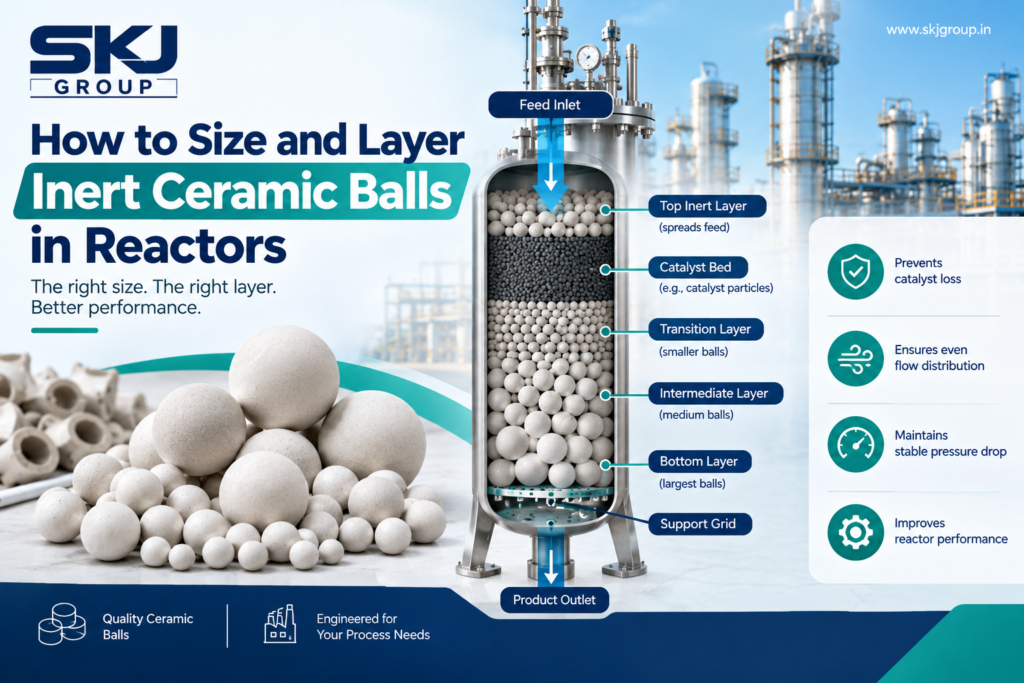
Size inert ceramic balls from the bottom up. The largest balls sit on the support grid and must be bigger than its openings, then each layer steps down in size toward the catalyst. A shallow top layer of inert balls above the catalyst spreads the feed and holds the catalyst in place. Your reactor drawing or catalyst loading diagram sets the exact sizes and depths, and your supplier’s job is to match them.
What Each Layer Is Actually Doing
A support bed looks like a pile of identical balls, but each layer has a different job. Get one wrong and you see it as catalyst loss, uneven flow or rising pressure drop.
- Bottom layer (largest balls): carries the weight of everything above, clears the grid or screen openings, and lets product drain freely.
- Middle layers (stepped sizes): form a transition so smaller balls and catalyst do not sift down into the gaps of the layer below.
- Top inert layer (shallow): spreads the incoming feed across the full cross-section and keeps catalyst particles from moving.
Before you order, send the grid opening, the catalyst size and your loading diagram to your ceramic ball supplier. Ball sizes chosen without those three inputs are guesses.
A Published Example, Layer by Layer
Here is one real layout from a published hydrogenation reactor design (US Patent 4,126,539), listed top to bottom with flow going down. It is an example of logic, not a recipe for your reactor.
| Position | Ball or catalyst size | Role |
| Top of bed, under the distributor | 1/2 or 3/4 in (13 or 19 mm) balls, shallow layer | Spreads feed, holds catalyst down |
| Catalyst sections | About 1/8 in and 1/16 in catalyst | The working bed |
| Support stack, top | 1/4 in (6 mm) balls | Transition from catalyst to balls |
| Support stack, middle | 1/2 in (13 mm) balls | Next step up in size |
| Support stack, bottom | 3/4 in (19 mm) balls | Rests on the grid |
| Support grid | Openings of about 3/8 in (10 mm) | Holds the whole stack |
What this example teaches:
- The largest balls were about twice the grid opening, so they could not slip through.
- At least three ball sizes were used, not one.
- No step was bigger than about 2 to 1 between neighbouring layers.
Treat those as patterns to check with your catalyst supplier, not fixed rules.
Common Sizes and Their Inch Equivalents
Vessel drawings often use inches while orders use millimetres. These are the sizes most often used for refinery support beds.
| Millimetres | Inches | Typical position |
| 6 mm | 1/4 in | Toward the catalyst |
| 10 mm | 3/8 in | Transition layers |
| 13 mm | 1/2 in | Transition or top inert layer |
| 19 mm | 3/4 in | Toward the grid |
| 25 mm | 1 in | Toward the grid |
| 38 mm | 1 1/2 in | Largest layer on wider openings |
➜ Not sure which sizes fit your grid? Send us your drawing and get a sizing recommendation
A Simple Way to Size a Support Bed
- Start with the grid. Get the opening size from the vessel drawing. The bottom balls must be larger than it.
- Check the catalyst. Note the particle size at the bottom of the catalyst bed. This is where your smallest balls meet it.
- Step down in stages. Move from the grid size to the catalyst size in a few modest steps, not one big jump.
- Set each layer’s depth from the loading diagram. There is no universal depth, because it depends on the vessel and process.
- Add the shallow top layer if the design calls for it.
- Confirm operating conditions. Temperature, pressure and chemistry decide the ceramic grade.
- Get sign-off. Your process engineer or catalyst supplier should approve the final layout before ordering.
Worked Example: How Many Balls for One Layer?
Say a reactor has a 2.0 m internal diameter and the bottom layer of 19 mm balls is 0.30 m deep. Both numbers are assumed for illustration only.
- Area: π × (2.0 ÷ 2)² = about 3.14 m²
- Layer volume: 3.14 m² × 0.30 m = about 0.94 m³
- Mass: 0.94 m³ × the supplier’s packing density. At about 1,350 kg/m³, a figure typical for 19 mm balls, that is about 1.27 tonnes.
- Add the allowance your supplier recommends for handling and settling.
Always use your own supplier’s packing density for the exact grade and size, because it changes between them.
Mistakes That Cause Migration and Pressure Drop
- Using balls small enough to pass through the grid or screen openings.
- Jumping straight from very large balls to fine catalysts, so smaller pieces sift into the gaps.
- Mixing sizes inside one layer instead of keeping layers distinct.
- Skipping the top inert layer and letting the catalyst shift or flow spread unevenly.
- Loading layers unevenly, so depth varies across the vessel.
- Not recording the layer-by-layer loading diagram, which makes the next turnaround harder.
Grade Is a Separate Decision
Size decides where a ball sits. The grade decides whether it survives there. Alumina content from about 17% to 99% changes temperature limit, crush strength and acid resistance, and the right grade depends on your chemistry and operating temperature. We cover that choice in our guide to inert ceramic balls in refinery and gas processing plants, so it is not repeated here.
A dependable inert ceramic balls manufacturer will back the grade with crush strength data and dimensional checks, because balls that vary in size defeat the whole point of grading.
What to Ask Before You Order
- Which sizes and tolerances can you supply, in both mm and inches?
- What are the crush strength figures for each size?
- Can you supply a batch certificate with alumina content?
- Will you review my drawing before quoting?
- What allowance do you suggest for handling and settling?
A good inert ceramic balls supplier asks for your grid opening and catalyst size before quoting, not after you place the order.
Sourcing From Mandsaur
If you are looking for inert ceramic balls in Mandsaur, SKJ Group manufactures inert ceramic balls in the sizes and grades used for catalyst support and column support beds. Our team can talk through your layer plan with you before you commit to quantities.
Frequently Asked Questions
1. What size ceramic balls go at the bottom of a reactor?
The largest balls in the stack go at the bottom, sized so they cannot pass through the support grid or screen openings. In one published hydrogenation design, 3/4 inch (19 mm) balls rested on a grid with about 3/8 inch openings. Your vessel drawing sets your size.
2. How are inert ceramic balls layered in a reactor?
They are loaded in graded layers, largest at the bottom, stepping down toward the catalyst, with a shallow inert layer on top. Published designs commonly use at least three sizes.
3. What is the purpose of a support bed?
It carries the catalyst weight, keeps the catalyst from reaching the outlet, spreads flow evenly and lets product drain. The top inert layer also holds the catalyst in place.
4. How deep should each layer of balls be?
There is no universal depth. It comes from the reactor design or the catalyst supplier’s loading diagram, so use those figures.
5. Can I mix different ball sizes in one layer?
Generally no. Keep each layer to one size so the steps stay distinct and smaller balls do not fill the gaps in larger ones.
6. How do I calculate how many balls I need?
Multiply the vessel cross-section area by the layer depth to get the layer volume. Multiply by the supplier’s packing density for that size, then add a handling allowance.
Get Your Support Bed Right the First Time
A well graded support bed is cheap insurance for an expensive catalyst. If you are loading a new reactor or replacing worn support media, SKJ Group can help you match sizes and grades to your drawing.
➜ Request a Quote and Sizing Support and our team will walk you through options for your reactor.