Use of Inert Ceramic Balls in Refinery and Gas Processing Plants

Use of Advanced Ceramics in Heavy Duty Industrial Equipment
May 4, 2026
How to Choose the Right Ceramic Rings for Industrial Use
May 6, 2026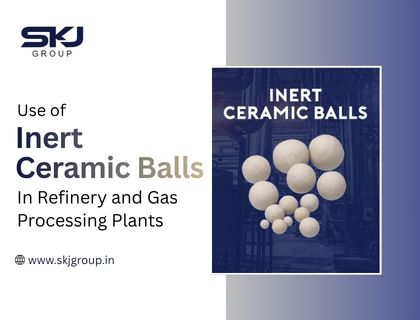
Inert ceramic balls are smooth, round ceramic components placed inside reactors, distillation columns, and gas processing vessels. They are called inert because they do not react with the chemicals, gases, or hydrocarbons flowing through the system. A reliable inert ceramic balls manufacturer produces these balls from materials like alumina and porcelain, with alumina content typically ranging from 17% to 99% depending on the application.
Fact: India operates more than 23 petroleum refineries with a combined processing capacity exceeding 250 million metric tonnes per year, according to the Petroleum Planning and Analysis Cell (PPAC) of the Government of India. Every one of these refineries uses ceramic catalyst bed support media and inert ball packing in multiple reactor and column systems. The demand for quality Inert Ceramic Balls in India is therefore large, consistent, and growing as refinery capacity continues to expand.
Gas processing plants face similarly demanding conditions. Natural gas streams contain hydrogen sulfide, carbon dioxide, water vapor, and heavier hydrocarbons that must be separated, absorbed, or removed using packed towers and reactor vessels. Inert ceramic balls in these systems provide the structural support and flow management needed for these processes to work efficiently.
Key Benefits of Inert Ceramic Balls for Modern Industrial Use
Understanding why refineries and gas plants rely on inert ceramic balls starts with their core performance benefits. These benefits directly address the harshest operating conditions found in modern industrial facilities.
1. Chemical Inertness
The most fundamental property is inertness. These balls do not react with hydrocarbons, sulfur compounds, acids, alkalis, or any of the other aggressive substances present in refinery and gas plant process streams. This means they do not contaminate the product and do not degrade through chemical attack over their service life.
2. Thermal Resistant Ceramic Balls for Refinery Use
Reactors in refineries and gas plants operate at high temperatures, often between 300°C and 700°C. Thermal resistant ceramic balls for refinery use maintain their shape, strength, and inertness throughout these temperature ranges. They do not soften, deform, or crack under sustained thermal load the way metal or plastic alternatives would.
3 .Mechanical Strength and Crush Resistance
Inside a packed reactor bed, ceramic balls sit under the combined weight of the catalyst and pack above them. A strong inert ceramic balls supplier provides balls with compressive strength values sufficient to bear this load without fracturing. Fractured balls create fines that block flow passages, increase pressure drop, and contaminate the catalyst bed.
4. Corrosion Resistant Ceramic Media for Gas Plants
Natural gas streams and refinery process fluids contain water, hydrogen sulfide, and organic acids that would corrode metal support media over time. Corrosion resistant ceramic media for gas plants made from alumina or porcelain remain unaffected by these substances, providing long service life without surface degradation.
5. Uniform Size and Shape
Well-manufactured inert ceramic balls from a quality inert ceramic balls manufacturer are produced to tight dimensional tolerances. Uniform size and round shape ensure predictable packing density and consistent flow distribution across the reactor cross-section. This consistency is critical for reactor performance and safe operation.
Applications of Inert Ceramic Balls in Refinery and Gas Processing Systems
Inert ceramic balls in refinery operations serve several distinct functions. Here is a clear breakdown of where and how they are used.
1. Catalyst Bed Support
This is the most widely known application. In fixed-bed reactors used for hydrodesulfurization, hydrocracking, catalytic reforming, and other refinery processes, layers of ceramic catalyst bed support media are placed below and above the catalyst bed. The bottom layers support the weight of the catalyst and allow treated product to drain from the reactor. The top layers hold the catalyst in place and distribute the incoming feed evenly.
Without proper inert ceramic balls as catalyst bed support, catalyst particles migrate downward, flow distribution becomes uneven, and reactor performance deteriorates.
2. Inert Ball Packing in Distillation Columns
At the base of distillation column packed sections, inert ball packing in distillation columns holds the packing media in place and prevents it from falling into the column sump below. Inert ceramic balls used in this role must be large enough to sit on the column support grid without passing through while allowing liquid and vapor to flow freely.
3. Feed Distribution in Reactors
A layer of inert ceramic balls placed immediately below the reactor inlet nozzle distributes the incoming feed stream evenly across the full cross-section of the reactor before it reaches the catalyst bed. Uneven feed distribution causes hot spots and reduces catalyst efficiency. Properly sized inert ceramic balls solve this problem at low cost.
4. Guard Beds for Catalyst Protection
In some refinery units, a guard bed of inert ceramic balls is placed upstream of the main catalyst bed to trap solid particles, scale, and catalyst poisons carried in the feed stream. This protects expensive catalysts from physical fouling and chemical poisoning, extending catalyst service life and reducing catalyst replacement costs.
5. Chemical Tower Packing Ceramic Balls
In gas absorption towers and acid gas removal units, chemical tower packing ceramic balls serve as inert bed support below structured or random packing sections. Their role is purely structural and protective, ensuring the packing above retains its designed orientation and that liquid from the column base drains cleanly without flooding the packing support.
Comparing Inert Ceramic Ball Types and Grades
A professional inert ceramic balls supplier produces balls in several grades. Selecting the right grade for your application prevents premature failure and unnecessary cost. Here is a comparison:
| Ceramic Ball Grade | Alumina Content | Temperature Limit | Key Strength | Best Application |
| Ordinary Porcelain | 17% to 23% | Up to 1000°C | Low cost, general use | Low-temperature distillation column support |
| Medium Alumina | 60% to 75% | Up to 1300°C | Better hardness and chemical resistance | General refinery reactor support beds |
| High Alumina 92% | 92% | Up to 1500°C | High crush strength, acid resistance | HDS and reforming reactor catalyst support |
| High Alumina 95% | 95% | Up to 1600°C | Very high temperature and wear resistance | High-temperature reactors, guard beds |
| High Alumina 99% | 99% | Above 1700°C | Maximum purity, inert in all environments | Critical catalyst support in high-purity processes |
The correct grade depends on your reactor operating temperature, the chemicals present in the process stream, and the mechanical load on the support bed. A qualified inert ceramic balls manufacturer will recommend the appropriate grade after reviewing your process conditions.
Inert Ceramic Balls in Mandsaur: A Reliable Supply Source for Refineries
Inert Ceramic Balls in Mandsaur refers to the established ceramic manufacturing capability centered in Mandsaur, Madhya Pradesh. This region has developed into a recognized production hub for industrial ceramic balls supplying refineries, petrochemical plants, and gas processing facilities across India.
Manufacturers in Mandsaur produce inert ceramic balls in multiple grades and sizes, with production capabilities serving both large-volume domestic orders and export requirements. Several inert ceramic balls exporters operating from this region supply to buyers in the Middle East, Southeast Asia, and Africa.
When evaluating an inert ceramic balls supplier or manufacturer, confirm the following before placing an order:
- Alumina content certification for the grade being supplied
- Compressive strength test data confirming crush resistance values
- Dimensional inspection reports confirming size tolerances
- Chemical resistance confirmation for your specific process chemicals
- ISO 9001 certification confirming quality management systems
- Production capacity and confirmed delivery timeline for your required volume
Sourcing from a domestic inert ceramic balls manufacturer in India reduces lead times and import costs for Indian refineries. For international buyers, Indian inert ceramic balls exporters offer competitive pricing with full export documentation and material certification support.
Case Study
Background: A natural gas processing plant in Gujarat was experiencing a persistent problem with rising pressure drop across its amine absorber unit used to remove hydrogen sulfide from natural gas streams. The pressure drop had increased by over 40% from the initial commissioning baseline over an 18-month period.
Challenge: The plant technical team investigated and found during a scheduled shutdown that the inert ball support layer at the base of the absorber had partially fragmented. The balls originally installed were low-grade porcelain with 17% alumina content. The combination of the mildly acidic gas stream and the operating temperature of 150°C had caused surface degradation and gradual ball fragmentation over time. Fragments had migrated into the packing above, causing partial blockage of flow channels and the observed pressure drop increase.
Solution: The plant engineering team contacted a certified inert ceramic balls manufacturer and selected 92% high alumina balls as the replacement grade. The higher alumina content confirmed resistance to the process chemicals at the operating temperature. Compressive strength data confirmed the new balls would withstand the mechanical load of the packing bed above them without fracturing.
Installation: The fragmented low-grade balls and contaminated packing section were removed during the planned shutdown. New 92% alumina inert ceramic balls were installed in the support layer in two graded sizes to prevent migration. The rest of the absorber packing was reinstalled above the new support bed.
Results after 30 months of operation:
- Pressure drop across the absorber returned to the original commissioning baseline immediately after restart
- No fragmentation or surface degradation observed during an intermediate inspection at 18 months
- Hydrogen sulfide removal efficiency returned to full design specification
- No unplanned shutdowns caused by pressure drop problems during the 30-month monitoring period
- Annual maintenance cost for the absorber unit reduced by approximately 50% compared to the previous operating cycle
- The plant engineering team confirmed the payback period for the ceramic upgrade was under 10 months
Lesson: Selecting the correct grade of inert ceramic balls from a knowledgeable inert ceramic balls supplier is a critical engineering decision, not a minor procurement detail. Upgrading from low-grade porcelain to high alumina balls completely resolved a persistent operational problem and delivered clear, measurable savings within a single operating cycle.
Frequently Asked Questions About Inert Ceramic Balls
Q1. What are inert ceramic balls used for in refineries?
Inert ceramic balls are used in refineries as catalyst bed support media, reactor feed distributors, guard bed materials, and column packing supports. Their chemical inertness and mechanical strength protect expensive catalyst beds, improve flow distribution, and extend reactor service intervals.
Q2. What is the difference between inert ceramic balls and catalyst support balls?
Inert ceramic balls and catalyst support balls are often the same product used interchangeably. Both refer to non-reactive ceramic spheres placed in reactor beds to support catalyst material. The term catalyst support balls emphasizes their function, while inert ceramic balls emphasizes their non-reactive material property.
Q3. What alumina content is recommended for refinery reactor applications?
For most refinery reactor applications, 92% to 95% alumina content is recommended. For the most demanding high-temperature or highly corrosive applications, 99% alumina provides maximum performance. A qualified inert ceramic balls supplier can confirm the correct grade based on your operating temperature and process chemistry.
Q4. How long do inert ceramic balls last in a reactor bed?
With correct grade selection and careful installation, inert ceramic balls typically last through multiple catalyst change-out cycles, often 5 to 10 years or longer. Service life depends on operating temperature, chemical exposure, and mechanical load in the specific reactor application.
Q5. What sizes of inert ceramic balls are available from manufacturers in India?
Inert ceramic balls manufacturers in India typically supply sizes from 3mm to 75mm in diameter. Common sizes for refinery catalyst support applications include 6mm, 10mm, 13mm, 19mm, 25mm, and 38mm. Custom sizes can be produced for specific project requirements by an experienced inert ceramic balls manufacturer.
Q6. Can inert ceramic balls handle high-pressure reactor conditions?
Yes. High alumina inert ceramic balls with 92% or higher alumina content have sufficient compressive strength to handle the pressure conditions found in standard refinery reactors. Confirm the compressive strength data for the specific grade with your inert ceramic balls supplier before specifying for high-pressure applications.
Q7. Do inert ceramic ball exporters from India supply documentation for international orders?
Yes. Established inert ceramic balls exporters from India provide full export documentation including material test certificates, dimensional inspection reports, alumina content certifications, packing lists, and certificates of conformity. This documentation is essential for import clearance and quality verification at the destination.
Q8. How do I choose the right inert ceramic ball size for my reactor?
Ball size selection depends on the reactor diameter, the catalyst particle size directly above the support layer, and the column support grid opening dimensions. A general guideline is to use graded layers with the largest balls at the bottom and progressively smaller sizes moving upward toward the catalyst bed. Consult the technical team of your inert ceramic balls manufacturer for a detailed sizing recommendation based on your reactor design.
Conclusion
Inert ceramic balls are a foundational component in refinery and gas processing plant operations worldwide. Their chemical inertness, thermal resistance, mechanical strength, and corrosion resistance make them the reliable choice for catalyst bed support, feed distribution, guard beds, and column packing support in the most demanding industrial reactor environments. As India’s refining and gas processing capacity continues to grow, the demand for quality Inert Ceramic Balls in India will remain strong and consistent. Working with a certified inert ceramic balls manufacturer who provides documented quality data, the correct ceramic grade, and dependable technical support is essential for any refinery or gas plant that depends on reactor performance and process reliability. With manufacturing hubs like Mandsaur providing domestic and international supply capability, Indian industry has access to world-class inert ceramic solutions at competitive prices backed by proven engineering expertise.